Back to all articles

Observability articles

Data observability and monitoring — pipeline health, table metrics, anomaly detection, alerting, and end-to-end visibility across your data stack.

18 articles

Apache Iceberg at scale — infrastructure, performance, and enterprise lessons
Apache IcebergData PlatformsLakeOpsLakehouse

Apache Iceberg at Scale: Infrastructure, Performance, and Enterprise Lessons

Running Iceberg at 10 tables is configuration. Running it at 10,000 is infrastructure. Production lessons on infrastructure evolution, Parquet tuning, Spark configuration, catalog scaling, enterprise security, and observability-driven optimization for production Iceberg deployments.

David W
David W
33 min read
Apache Iceberg lakehouse observability — monitoring what matters in production
Apache IcebergObservabilityLakeOpsLakehouse

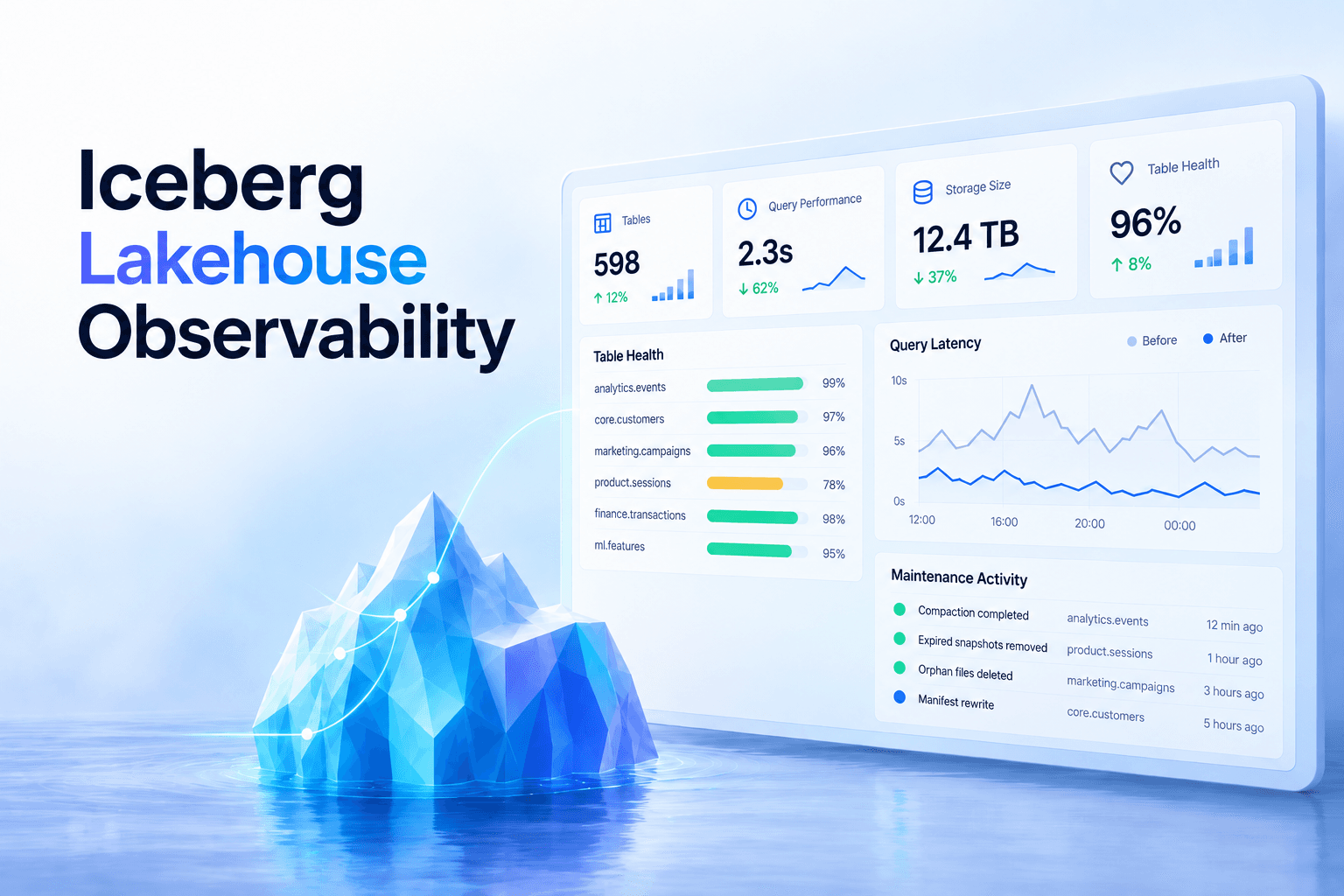
Iceberg Lakehouse Observability: Monitor Table Health, Costs, and Query Performance

Apache Iceberg does not ship with observability — data platform teams need table health, engine metrics, cost attribution, and lineage across Spark, Trino, and Flink. The seven pillars of lakehouse monitoring and how a control plane makes it operational.

Jonathan Saring
Jonathan Saring
29 min read
Apache Iceberg Data Quality and Table Health — where reliability actually breaks, healthy vs unhealthy comparison
Apache IcebergObservabilityLakeOpsData Lake

Apache Iceberg Data Quality and Table Health: Where Reliability Actually Breaks

Data quality and table health are different failure modes — one breaks business trust, the other breaks performance silently. A practical guide to the metrics, monitoring queries, classification frameworks, and automated remediation that keep Iceberg tables reliable in production.

David W
David W
26 min read
Apache Iceberg Schema Evolution in Production — best practices and pitfalls, with schema version progression from v1 through v4
Apache IcebergData GovernanceLakeOpsLakehouse

Apache Iceberg Schema Evolution in Production: Best Practices and Pitfalls

Schema evolution is one of Iceberg's most powerful features — but misusing it in production causes silent downstream failures, broken statistics, and multi-engine inconsistencies. A practical guide to safe schema changes, column ID mechanics, partition evolution, branch-based testing, rollback strategies, and monitoring schema drift across the lakehouse.

Rob M
Rob M
28 min read
Apache Iceberg Retention Policy — how long to keep snapshots, from newest to oldest with expired snapshot cleanup
Apache IcebergCloud CostLakeOpsData Lake

Apache Iceberg Retention Policy: How Long Should You Keep Snapshots?

Every Iceberg commit creates a snapshot. Left unmanaged, snapshots pin storage, inflate metadata, and slow query planning. This guide covers what snapshots actually cost, retention strategies by workload type, the retain_last vs older_than tradeoffs, compliance via tags and branches, the cascade from snapshots to orphan files to manifest bloat, and how to set automated retention policies that match your operational reality.

Rob M
Rob M
32 min read
Apache Iceberg Operational Runbook — incidents, symptoms, and fixes with detect, diagnose, resolve, and verify workflow
Apache IcebergObservabilityLakeOpsCompaction

Apache Iceberg Operational Runbook: Incidents, Symptoms, and Fixes

A production-ready runbook for Iceberg incidents: queries suddenly slow, planning takes minutes, write conflicts spike, storage grows uncontrolled, compaction OOMs, time travel breaks, and delete files degrade reads. Each incident follows Symptom → Root Cause → Diagnosis → Fix → Prevention.

David W
David W
24 min read
Apache Iceberg Production Readiness Checklist for Enterprise Data Lakes — security, storage, operations, and governance
Apache IcebergProduction ReadinessLakeOpsLakehouse

Apache Iceberg Production Readiness Checklist for Enterprise Data Lakes

Taking Apache Iceberg from proof-of-concept to enterprise production requires decisions across ten operational dimensions — catalog architecture, table design, write path tuning, maintenance automation, observability, multi-engine coordination, security, disaster recovery, cost management, and on-call readiness. This checklist covers each one with concrete configurations, SQL examples, and the automation patterns that keep large-scale lakehouses healthy.

Rob M
Rob M
24 min read
Automating Apache Iceberg Table Maintenance — compaction, snapshot expiration, orphan cleanup, manifest rewrite, and table health orbiting an Iceberg table.
Apache IcebergCompactionLakeOpsObservability

Automating Apache Iceberg Table Maintenance

Apache Iceberg ships the maintenance primitives — compaction, snapshot expiration, orphan cleanup, and manifest rewriting — but none of them run themselves. This guide covers why each operation matters, the correct execution order, the limitations of scripts and cron jobs, and how to automate the full lifecycle with policies, observability, and a purpose-built control plane.

Chris P
Chris P
21 min read
Intelligent Lakehouse — Build like Netflix. LakeOps control plane with observability, optimization, policies, and routing over Spark, Trino, Presto, and BI/ML on Iceberg and S3. 10x query performance, up to 80% lower storage costs, reliable at massive scale, fully automated.
Apache IcebergLakeOpsLakehouseData Platforms

Intelligent Lakehouse: Build Like Netflix

Netflix spent years building an intelligent lakehouse — Polaris for catalog management, Autotune for compaction, janitors for cleanup, and Metacat for observability. LakeOps lets every team build the same — and go beyond — in minutes. Here is what an intelligent lakehouse actually requires, and how LakeOps provides each component.

Jonathan Saring
Jonathan Saring
19 min read
Apache Iceberg Puffin Statistics — a puffin bird beside a statistics dashboard showing file counts, records, partitions, and data size, connected to a geometric iceberg
Apache IcebergLakeOpsAnalyticsObservability

Apache Iceberg Puffin Statistics: A Practical Guide

Puffin files store table-level statistics — NDV sketches and custom blobs — that query engines use for join ordering, split planning, and cost-based optimization. A practical guide to how they work, how to collect them, how they go stale, and how to keep them accurate at scale.

David W
David W
18 min read
Apache Iceberg Table Health and Maintenance — health score dashboard showing 92 Healthy with status indicators for Snapshots, Manifests, Delete Files, Orphan Files, and File Health beside a geometric iceberg
Apache IcebergCompactionObservabilityLakeOps

Apache Iceberg Table Health and Maintenance: A Complete Guide

Iceberg tables degrade silently in production — small files multiply, snapshots accumulate, orphans waste storage, and manifests fragment. A comprehensive guide to the five maintenance operations, why sequencing matters, the metrics that reveal problems early, and how to automate the full lifecycle.

David W
David W
20 min read
LakeOps Data Lake Insights showing metadata health alerts across Iceberg tables — manifest fragmentation, snapshot accumulation, and partition skew
Apache IcebergData PlatformsData LakeLakeOps

Iceberg Metadata Lifecycle: Maintenance and Optimization

A deep technical guide to managing the metadata layer that makes Apache Iceberg fast — snapshots, manifests, metadata.json files, and Puffin statistics — covering expiration, consolidation, orphan cleanup, and the sequencing that prevents production incidents.

Jonathan Saring
Jonathan Saring
19 min read
LakeOps lakehouse control plane — connected to Iceberg catalogs on the left, query engines on the right, with observability, autonomous optimization, and cost management in the center
Apache IcebergLakeOpsLakehouseFinOps

Iceberg Lakehouse Optimization with LakeOps

A practical walkthrough of optimizing an Apache Iceberg lakehouse end to end — from connecting catalogs and diagnosing table health through autonomous compaction, lifecycle management, and multi-engine routing to measurable cost and performance outcomes.

Rob M
Rob M
16 min read
From data swamp to modern Iceberg lakehouse — illustrated journey from scattered files and broken schemas through Apache Iceberg to a managed lakehouse with a control plane
Data PlatformsApache IcebergLakehouseLakeOps

From Data Swamp to Modern Iceberg Lakehouse

Every data lake starts with a promise of unlimited flexibility — and most end up as a swamp. Stale files, broken schemas, no observability, and engineers spending more time maintaining pipelines than analyzing data. Apache Iceberg fixed the reliability gap. A lakehouse control plane fixes everything else. A practical guide to the full transition — component by component.
Jonathan Saring
Jonathan Saring
23 min read
Iceberg lakehouse optimization — multi-engine ecosystem (AWS, Databricks, Trino, DuckDB, Snowflake, Flink, and more) around a shared Iceberg lake, with observability and optimization above the waterline
Apache IcebergLakehouseLakeOpsObservability

Iceberg Lakehouse Optimization — The Right Way

Apache Iceberg gives your lakehouse warehouse-grade reliability on object storage — but the format does not optimize itself. A practical guide to every operational pillar a production Iceberg lakehouse needs — from lake-wide observability and query-aware compaction to snapshot lifecycle, metadata health, and governance — and how LakeOps runs it all from a single control plane.

Jonathan Saring
Jonathan Saring
21 min read
LakeOps table metrics showing records distribution, file size distribution, and table size growth over the last 30 days
Apache IcebergLakeOpsFinOpsData Platforms

Autonomous Iceberg Table Maintenance for Data Lakes

Iceberg tables need continuous maintenance — compaction, snapshot expiration, manifest optimization, and orphan cleanup — but manual scripts break at scale. A deep look at what autonomous table maintenance means in practice: how telemetry-driven orchestration replaces reactive firefighting and keeps every table healthy without human intervention.

Rob M
Rob M
16 min read
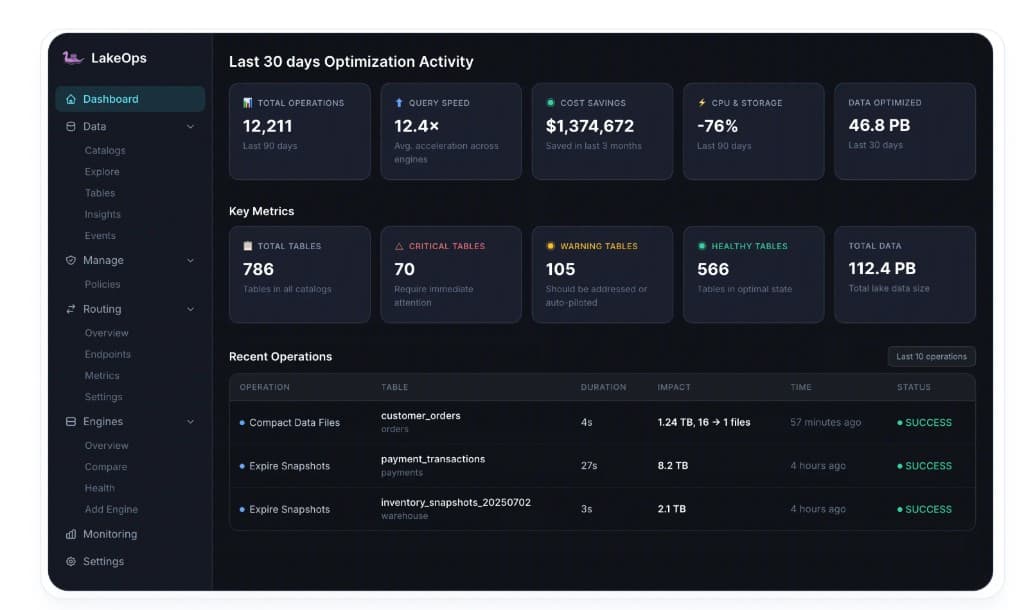
LakeOps dashboard showing optimization activity, key metrics, and recent operations across production Iceberg tables
Apache IcebergLakeOpsFinOpsData Platforms

Managed Iceberg in 2026: Autonomous Data Lake

Iceberg tables degrade silently — small files pile up, snapshots bloat metadata, and query latency creeps higher. A breakdown of the nine components every production data lake needs to stay healthy — starting with observability and telemetry collection, through compaction, snapshot management, and lake-wide policies, to multi-engine routing and agentic AI enablement.

Jonathan Saring
Jonathan Saring
23 min read
Why Every Data Lake Needs a Control Plane: Lessons from Apache IcebergExternal
Apache IcebergData LakeLakeOpsLakehouse

Why Every Data Lake Needs a Control Plane: Lessons from Apache Iceberg

Apache Iceberg delivers speed, but without a control plane snapshots pile up, costs surge, query take more time — starting with expiration.

LakeOps Team
8 min read