




Solutions

Cost down. Performance up.Agentic AI ready.

LakeOps automates compaction, snapshot hygiene, and routing while you keep your existing tables, catalogs, and engines. Reduce spend, improve latency, and keep table health visible in one control plane—then enable agent-ready data and multi-engine routing when your team is ready.

-80%
CPU & storage costs
12×
faster queries
100%
autonomous management

Results

Measured impact on
real Iceberg workloads

Benchmarks from production-grade tables across multiple engines and cloud providers.

Compaction speed

95%faster

vs. Apache Spark on identical datasets

Spark
LakeOps
+ Sort

Query performance

12×faster

After compaction + layout optimization

Cost savings

80%reduction

In compute & storage spend

TPC-DS benchmark suiteProduction Iceberg tablesMulti-cloud, multi-engine

What your data platform gains

One control plane to optimize, observe, and automate your lake—consistently across engines, clouds, and workloads.

$
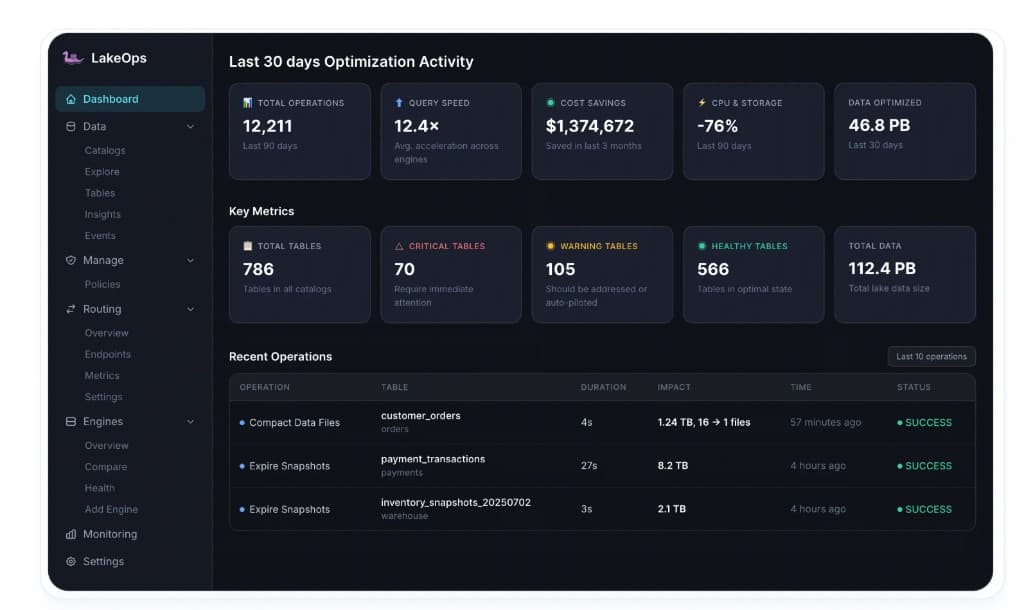
Cost savings

$1,374,672

Saved in last 3 months

CPU & storage

-76%

Resources saved in last 3 months

Up to 80% cost reduction

LakeOps analyzes real query patterns and table telemetry to decide what to compact, when, and how aggressively. A Rust-based engine runs compaction up to 20× faster than Spark with a fraction of the compute, so you stop paying for idle clusters and over-provisioned jobs. Orphan files, expired snapshots, and bloated manifests are cleaned continuously—storage costs drop without anyone writing a script.

Query speed
Live

Avg. acceleration across engines

12.4×

Incredible query performance

LakeOps continuously reshapes data layout based on actual query patterns—sort order, file sizes, and partition structure all adapt to how your tables are really used. Engines scan less data, planners prune faster, and manifests stay lean. The result: up to 12× faster queries across Trino, Spark, and Snowflake without changing a single query or pipeline.

Recent maintenance
Last 10 operations
OperationTableSize reclaimed
Bin-pack compaction
orders4.2 TB
Expire snapshots
events_stream1.8 TB
Orphan file cleanup
raw_clicks920 GB
Manifest rewrites
customer_360

Automated table optimization

Set policies once—LakeOps handles the rest. It monitors every table for small files, stale snapshots, orphan data, and metadata bloat, then runs the right operation at the right time: bin-pack compaction, sort-order optimization, snapshot expiration, manifest rewrites, and orphan cleanup. All orchestrated safely in the background with conflict-aware scheduling across concurrent writers.

Table health
Small file hotspots12 tables
Snapshot bloat3
Partition skew7 tables

One view, all catalogs

Visibility and control

See every table's health in one place: small-file counts, partition skew, snapshot depth, storage cost by engine, and optimization history. Drill into any table for file-size distributions, record counts over time, and partition-level metrics. Set alerts on drift, trigger one-click remediation, or let policies handle it—full observability with guardrails instead of guesswork.

Agentic AI readiness
Agent-native MCPConnected
Guardrails & governanceActive
Intelligent routingAdaptive
Self-optimizing lakeLearning

Agentic AI readiness

AI agents need fast, well-organized data and safe SQL access. LakeOps exposes an agent-native MCP interface so agents can query, discover, and act on your lake directly. Layered guardrails limit what agents can touch, intelligent routing sends agent queries to the right engine at the right cost, and the lake self-optimizes in a closed loop—learning from every query to keep data agent-ready.

Query router

Cost, latency & table-aware routing

One policy layer · many engines
Interactive / BI
TrinoLow latency
Large rewrite
SparkParallel scan
Streaming job
FlinkStream affinity

Adaptive + LLM + semantic routers · cached decisions

Multi-engine query routing

One policy layer routes queries across Trino, Spark, Flink, Athena, Snowflake, and Databricks. LakeOps picks the engine per query using cost ceilings, latency targets, table health, and historical patterns—interactive dashboards hit low-latency engines while heavy ETL and compaction land where compute is cheapest. No duplicate configs, no per-engine tuning.

Minutes to value with no risk

1

Connect & collect telemetry

Apache Iceberg
AWS
Snowflake
Trino
2

Manual or autonomous management

Manual
Autonomous
3

Operations run & optimize

Compaction
Snapshots
Orphan cleanup
Manifests & metadata
4

Observability & governance

Metrics
Health
Agents
Routing
Logs
Policies
No vendor lock-in
No code / infra changes
No data changes

Runs on your stack

AWS
Azure
Google Cloud
Snowflake
Databricks
Apache Flink
Apache Hadoop
Apache Iceberg
Delta Lake
Spark
Lakekeeper
StarRocks
AWS
Azure
Google Cloud
Snowflake
Databricks
Apache Flink
Apache Hadoop
Apache Iceberg
Delta Lake
Spark
Lakekeeper
StarRocks

See it in action

Turn these outcomes on for your lake

Get a walkthrough of how LakeOps applies policies, runs optimization, and surfaces impact across engines—on your own tables.

Loved by data platform teams

LakeOps took the pain out of compaction and maintenance. We went from ad-hoc scripts and firefighting to a single control plane. Query performance improved and our platform team finally has visibility across the lake.
Shira B., Staff Data Platform Engineer
Shira B.
Staff Data Platform Engineer

Production benchmarks

5.5 TB across 10 production tables

Real workloads. Real data. Batch, streaming, delete-heavy, multi-writer, and terabyte-scale tables — all on the same engine, same hardware.

101K → 19K
files (81% reduction)
2,522 MB/s
peak throughput
99.8%
max file reduction
551M
deleted rows cleaned
TableSizeWorkloadFiles (B → A)ThroughputTimeNotes
balance_snapshots1,192 GBTB-Scale batch11,9573,2701,572 MB/s11 minSpark OOM on same hardware
user_accounts174 GBBatch8784002,269 MB/s74sSingle Node
events_analytics484 GBDelete-Heavy16,1287,198729 MB/s11m 21s23,433 delete files; 551M rows removed
raw_sdk_events8 GBStreaming42,63369167 MB/s138s99.8% file reduction
site_traffic292 GBMulti-Writer2,7407541,465 MB/s3m 25sSingle partition
cluster_registry322 GBBatch9984402,522 MB/s2mPeak throughput

Compaction cost per TB

Normalized to Spark = 100%

Apache Spark100%
AWS S3 Tables / Databricks100%
LakeOps10%

Source: 200 GB (~1 TB uncompressed) benchmark. Spark cost index 100 vs LakeOps 10.

Self-improving: same table, zero config changes

balance_snapshots — 1.192 TB across consecutive runs

Run 122 min · 925 MB/s
Run 218 min · 1,100 MB/s
Run 3 (learned)11 min · 1,572 MB/s

Same data and hardware; planner learns workload telemetry and improves runtime from 22 to 11 minutes.