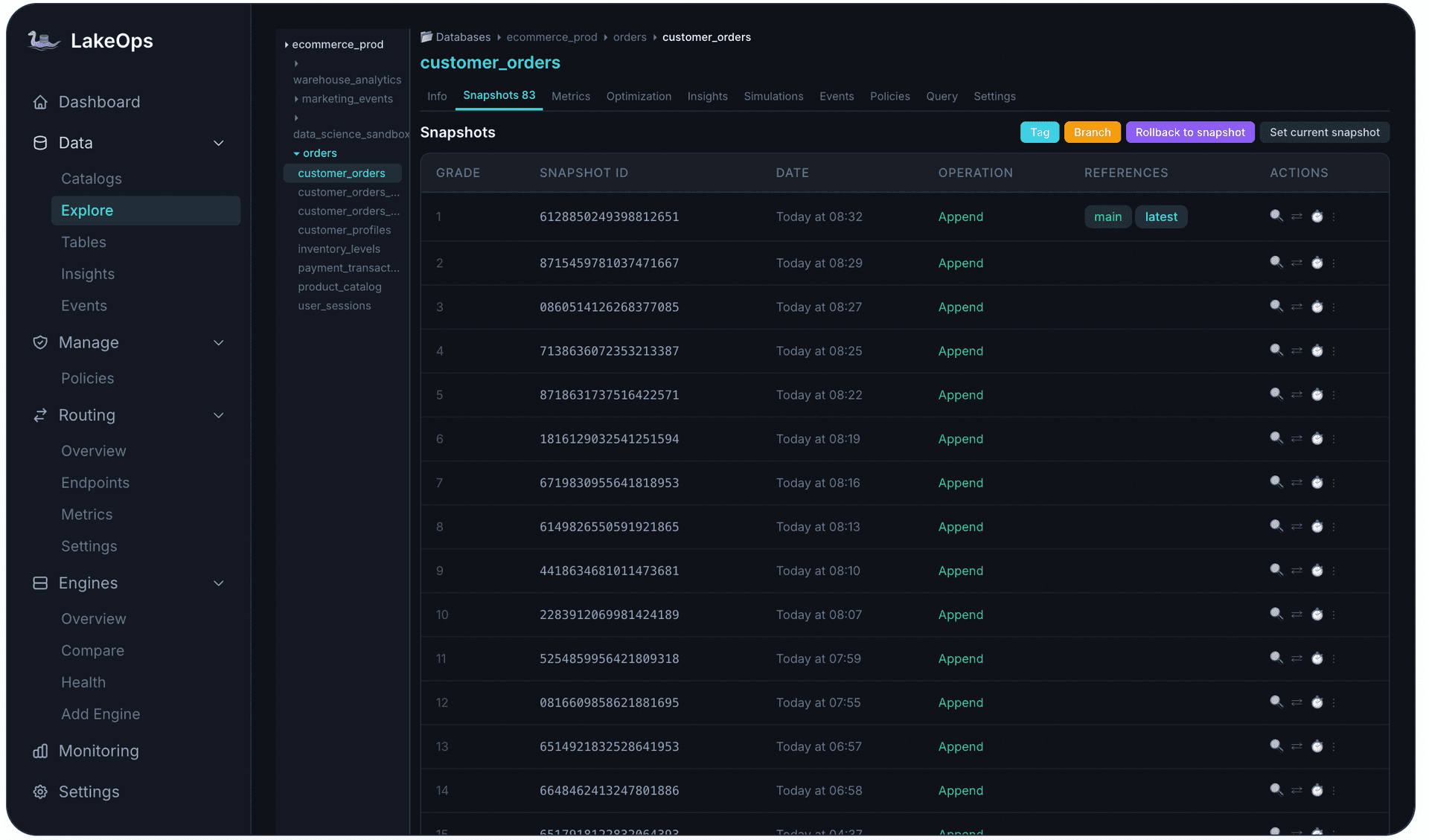
Snapshot Retention and Time Travel: A Guide
Iceberg snapshots enable time travel, rollback, and audit — but accumulate indefinitely unless managed. A practical guide to retention strategies, expiration safety, and automated lifecycle management.
Cloud cost optimization for data lakes and lakehouses — storage waste, compute spend, query pricing, and strategies to cut lakehouse costs.
14 articles

Iceberg snapshots enable time travel, rollback, and audit — but accumulate indefinitely unless managed. A practical guide to retention strategies, expiration safety, and automated lifecycle management.

Athena charges $5 per TB scanned — and on poorly maintained Iceberg tables, every query scans far more data than it should. This guide breaks down why Athena bills explode on Iceberg (small files, bad sort order, stale manifests, scan amplification) and presents two paths to fix it: autonomous optimization with LakeOps or the manual approach with Athena SQL and Spark.

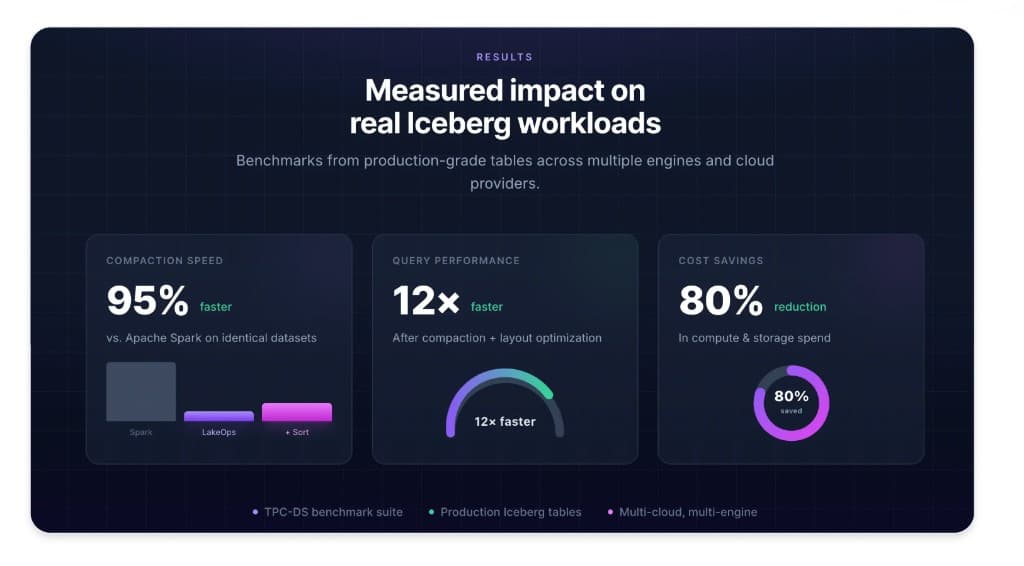
Spark compaction is expensive, slow, and architecturally wrong for file rewrites. Here's how to replace it with purpose-built engines that cost 90% less and finish 95% faster — plus the DIY path if you want to optimize what you already have.

Orphan files are invisible to Iceberg but fully billable by cloud storage. They accumulate silently from failed writes, crashed compaction, and concurrent conflicts — and on mature lakes they can account for 25–40% of storage spend. This guide covers how orphan files are created, how to detect them safely, the retention window that prevents table corruption, and how to automate cleanup at lake scale without listing millions of objects.

Every Iceberg commit creates a snapshot. Left unmanaged, snapshots pin storage, inflate metadata, and slow query planning. This guide covers what snapshots actually cost, retention strategies by workload type, the retain_last vs older_than tradeoffs, compliance via tags and branches, the cascade from snapshots to orphan files to manifest bloat, and how to set automated retention policies that match your operational reality.

Apache Iceberg on AWS S3 is the standard architecture for open lakehouses. This guide covers how Iceberg's metadata hierarchy maps to S3 objects, the AWS services ecosystem (Glue, Athena, EMR, Redshift, S3 Tables), configuration best practices, performance optimization, table maintenance, and the operational components needed for production deployments.

AWS S3 bills for Iceberg lakehouses are inflated by small files, orphan data, retained snapshots, metadata overhead, and scan amplification. This guide quantifies each cost vector with S3 pricing mechanics and walks through five strategies — compaction, expiration, layout optimization, storage tiering, and engine routing — to cut storage and query spend.

A practical guide for senior data engineers expanding Snowflake into a multi-engine Iceberg lakehouse. Covers five production tools — LakeOps, managed Iceberg, Open Catalog sync, Spark, and AWS Glue — with migration patterns, operational trade-offs, and a phased rollout sequence.

State of Iceberg FinOps in 2026: where lakehouse spend leaks, what to measure, how autonomous management and optimization are replacing manual maintenance — and a practical survey of tools from cloud optimizers to control planes.

Iceberg lakehouses silently accumulate cost from small files, dead snapshots, orphan data, unoptimized layouts, and over-provisioned compute. Seven practical strategies — from deploying an autonomous control plane to leveraging partition evolution — that production data teams use to cut lakehouse spend by up to 80%.

Iceberg tables need continuous maintenance — compaction, snapshot expiration, manifest optimization, and orphan cleanup — but manual scripts break at scale. A deep look at what autonomous table maintenance means in practice: how telemetry-driven orchestration replaces reactive firefighting and keeps every table healthy without human intervention.

Your Iceberg lake is overcharging you from four directions at once — storage bloat, query compute waste, compaction overhead, and engineering time. This post breaks down exactly where each dollar goes and how autonomous table management eliminates the waste without touching your pipelines.

Iceberg tables degrade silently — small files pile up, snapshots bloat metadata, and query latency creeps higher. A breakdown of the nine components every production data lake needs to stay healthy — starting with observability and telemetry collection, through compaction, snapshot management, and lake-wide policies, to multi-engine routing and agentic AI enablement.
See how a 350TB data lake shrank to 230TB in 10 minutes by removing stale data—saving 34% in AWS S3 costs and proving the need for a control plane.