
Every data platform team is hearing the same mandate: make our data available to AI agents. The models are ready. The agent frameworks are mature. The use cases — conversational analytics, autonomous data quality monitoring, AI-driven feature engineering, intelligent reporting, self-healing pipelines — are no longer hypothetical. Google Cloud is rebuilding its lakehouse for "the agentic era." Dremio, Databricks, and Snowflake are all racing to define the "agentic lakehouse" architecture. The industry has converged on a shared conclusion: your lakehouse needs to serve AI agents as first-class consumers, not just human analysts.
But there is a gap between "we have a data lakehouse" and "AI agents can reliably use our data." Most organizations discover this gap the hard way: an agent hallucinates table names, generates a query that scans 4 TB of uncompacted data, returns PII in plain text to an LLM context window, or simply times out on a table fragmented across 200,000 small files. The agent is not broken. The lakehouse is not AI-ready.
This guide is the definitive resource for making your Apache Iceberg lakehouse AI-ready. It defines what "AI-ready" means across six dimensions, explains why Iceberg is uniquely positioned as the foundation for AI-accessible data, provides a concrete readiness checklist with practical scoring, and shows how LakeOps delivers every component as a single control plane — turning your existing lakehouse into a platform that AI agents can query safely, efficiently, and autonomously. It is the companion to nine deep-dive articles that cover each topic in detail.
The AI-Data Gap: Why Your Lakehouse Is Not Ready
Organizations that invested in Apache Iceberg have already made the right architectural bet. They have open table formats, multi-engine flexibility, ACID transactions, and schema evolution. But table format adoption and AI readiness are two very different problems.
AI agents interact with data fundamentally differently than human analysts. A human runs a handful of queries per session, knows which tables to use, understands business logic, and catches dangerous queries before executing them. An AI agent runs dozens — sometimes hundreds — of SQL statements per reasoning step, improvises novel query shapes based on conversation context, and has no instinct to catch mistakes. For a deep look at how these query mechanics work in practice, see How AI Agents Query Apache Iceberg Data Using MCP and Natural Language.
A single user question like "Which product categories had declining margins last quarter?" can trigger a chain of 15–30 SQL statements: schema discovery, sampling, aggregation, drill-down, cross-validation, and formatting. Multiply that across hundreds of concurrent agent sessions, and the workload profile looks nothing like the BI traffic your lake was sized for.
This creates four structural problems.
Query volume spikes. An agent in a tool-use loop can issue 50+ queries per minute. Infrastructure sized for 100 concurrent dashboard users suddenly sees 5,000 agent-generated queries per minute. Traditional auto-scaling cannot keep pace because agent query patterns are not periodic — they are bursty, unpredictable, and shaped by conversation context.
Unpredictable query shapes. BI dashboards have stable query patterns. Agents improvise — generating novel SQL from conversation context, exploring unfamiliar tables, and accessing columns no one anticipated. They also generate structurally dangerous queries: cartesian joins, SELECT * on billion-row tables, nested CTEs wrapping mutations. Without guardrails, every agent session is a new attack surface. For the full taxonomy of dangerous agent queries and how to defend against them, see How to Give AI Agents Safe Access to Apache Iceberg Data in Production.
No built-in safety. A human who writes a dangerous query usually catches it. Agents have no such filter. Without guardrails, a misconfigured agent can scan petabytes, expose PII, run DDL against production tables, or generate unbounded compute spend — all within minutes, with no human in the loop. The 2026 Model Context Protocol specification now includes stateless transport and tool discovery, making MCP gateways the standard control point — but the gateway must enforce budgets, identity, and scope per session.
Latency compounds through reasoning chains. When an agent runs 12 sequential queries, each 3-second delay adds up to 36 seconds of wall-clock time. On uncompacted Iceberg tables with thousands of small files and fragmented manifests, even simple scans take 5–10 seconds due to S3 GET amplification and manifest listing overhead. Users perceive this as the agent being broken. For production agents that need sub-500ms response times, table health is not optional — it is the foundation everything else depends on. See How AI Agents Automate Apache Iceberg Table Maintenance and Compaction for the maintenance playbook.
The solution is not to restrict AI agents to pre-built dashboards or canned queries — that defeats the purpose. The solution is to make your lakehouse AI-ready: discoverable, queryable, governed, observable, maintainable, and connected through a standard protocol.
What "AI-Ready" Means for a Data Lakehouse
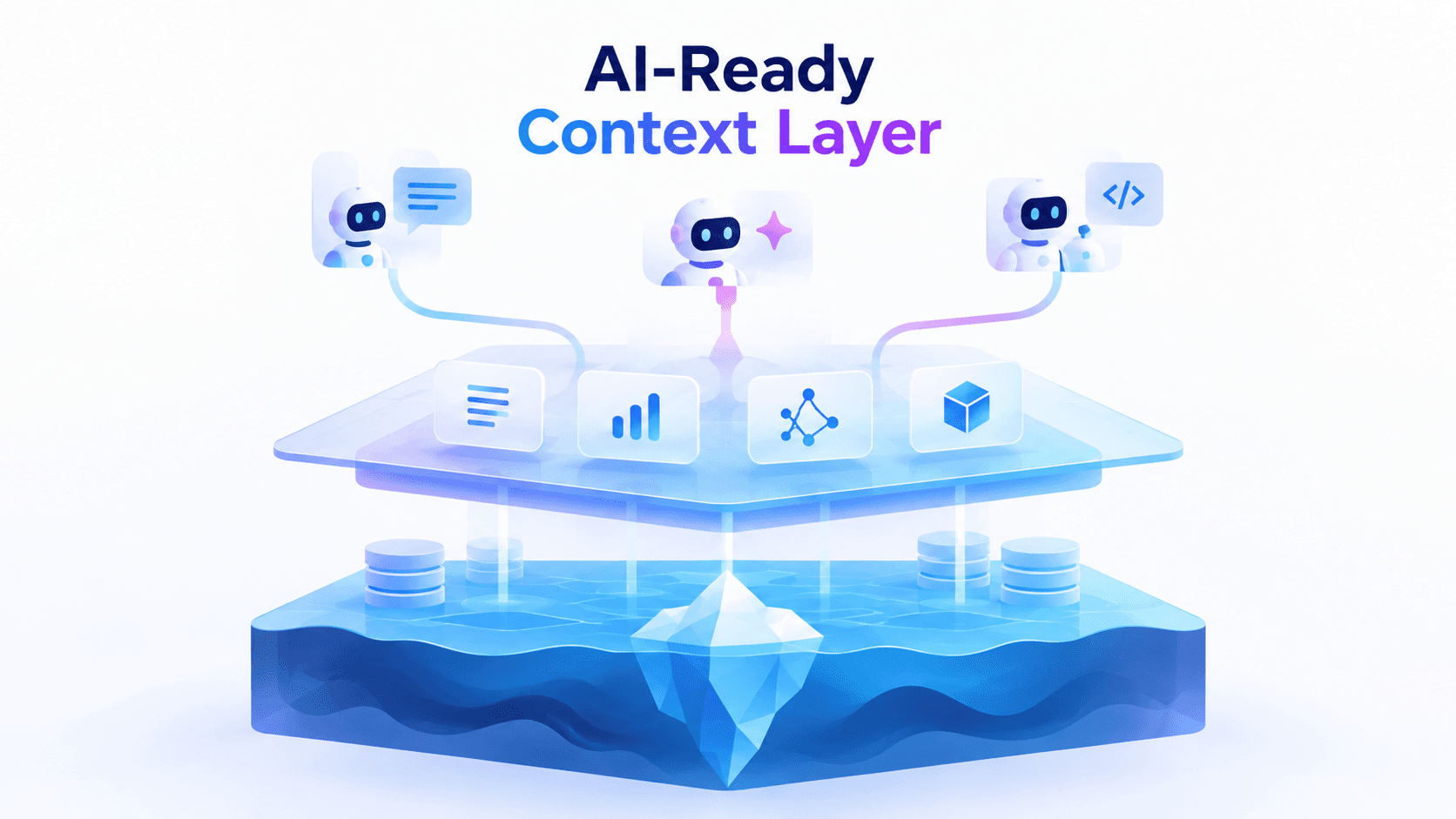
An AI-ready lakehouse is not just a lakehouse that agents can technically connect to. It is one where agents can operate reliably, safely, and efficiently at production scale. Six properties define AI readiness — and together they form the AI-Readiness Framework that every architecture decision should be evaluated against.
1. Discoverable
AI agents must be able to find and understand all available data without prior knowledge. This means programmatic access to catalog structures, namespace hierarchies, table schemas, column descriptions, partition specifications, and sort orders. An agent encountering your lakehouse for the first time should be able to answer "what data exists here?" in a single tool call — not through trial-and-error SQL that produces column-not-found errors and hallucinated table names.
Discovery is the foundation of agent accuracy. Industry analysis of agentic lakehouse architectures consistently shows that agents without structured discovery tools produce 3–5x more errors than agents with catalog-aware tool interfaces. When an agent can call list_catalogs → search_tables → get_schema in sequence, it eliminates hallucinated table names entirely.
For a comprehensive guide to agent-driven data discovery, see How AI Agents Discover and Explore Data in Apache Iceberg Lakehouses.
2. Queryable
Agents must be able to execute SQL queries safely and efficiently. This goes beyond raw JDBC access. It means sub-second query latency for interactive agent workloads, intelligent routing to the right engine for each query shape, bounded result sets that do not overflow LLM context windows, and pre-flight cost estimation so agents can evaluate whether a query is worth executing before committing resources.
Query capability also means wire compatibility. Agents built with different frameworks — Claude, LangChain, LlamaIndex, custom builds — connect through different protocols. A production-ready query layer must support PostgreSQL, MySQL, and Arrow Flight wire protocols so any agent can connect through standard database drivers and benefit from the full routing and guardrail stack.
For the complete query routing architecture, see Building an AI Agent Analytics System on Apache Iceberg Data.
3. Governed
Access controls, guardrails, and audit trails must be in place before the first agent query runs. Governance for AI agents operates at three levels: tool-level governance (what operations the agent can perform), query-level governance (what SQL patterns are permitted), and result-level governance (what data the agent actually receives). Each level needs enforcement in infrastructure, not in prompts — because prompts can be circumvented.
The emerging consensus across the industry — from Apache Polaris's credential vending to the agentic lakehouse gateway pattern — is that governance must be layered: the catalog narrows access to specific tables, the semantic layer narrows results to business-approved definitions, and the MCP gateway narrows tools to scoped, validated operations. Each layer is smaller than the one below it. This is the principle that makes agent governance auditable and enforceable.
See How to Give AI Agents Safe Access to Apache Iceberg Data in Production for the complete guardrail architecture.
4. Observable
Table health metrics, query performance data, and agent activity must be available for both humans and agents to reason about. This includes per-table health scores (healthy, warning, critical), per-agent cost attribution, guardrail audit logs, and session replay capabilities. Without observability, you cannot diagnose why an agent is slow, expensive, or returning wrong results.
Observability for AI workloads differs from traditional monitoring in one critical way: agents generate telemetry at 10–50x the volume of human analysts, and the telemetry must be attributed to specific agents, conversations, and reasoning steps — not just users or sessions.
5. Maintainable
Tables must be well-organized and performant. An agent hitting a table with 200,000 small files will time out regardless of how sophisticated your MCP layer is. Continuous compaction, snapshot expiration, manifest consolidation, and orphan cleanup are prerequisites for AI readiness — not optimizations. Uncompacted tables pay a 5–10x latency penalty that no amount of routing can compensate for.
Maintenance must also be intelligent. Traditional schedule-based maintenance — "compact everything at 2 AM" — wastes resources on idle tables and misses hot tables that degrade between runs. Query-aware maintenance observes which columns agents actually filter on and adjusts sort orders to match, creating a virtuous cycle where tables get faster the more agents use them. For the complete maintenance automation guide, see How AI Agents Automate Apache Iceberg Table Maintenance and Compaction and Self-Healing Data Pipelines with AI Agents and Apache Iceberg.
6. Connected
A standard protocol must bridge agents and data. The Model Context Protocol (MCP) has emerged as this standard — an open interface that exposes data operations as tool calls any LLM can invoke natively. MCP fills the same role for agent-to-infrastructure communication that REST catalogs fill for engine-to-catalog communication: a standardized, schema-aware interface that any compliant client can connect to without custom integration code.
The MCP gateway is where identity, session isolation, and budgets are enforced. A well-designed gateway does not just translate tool calls to SQL — it validates intent, scopes access, inspects results, and throttles output. This is the control surface that makes the difference between "agents can technically query data" and "agents can be trusted with production data." For a practical connection guide, see How to Connect AI Agents to Your Apache Iceberg Lakehouse with MCP.
The Iceberg Advantage: Why Iceberg Is the Foundation for AI
Not all table formats are equal when it comes to AI readiness. Apache Iceberg provides six structural advantages that make it the ideal foundation for an AI-accessible lakehouse.
Open Format, No Proprietary Lock-In
Iceberg is an open specification governed by the Apache Software Foundation. Your data is stored in open file formats (Parquet, Avro, ORC) on your object storage. No vendor controls the format, the metadata, or the access path. This matters for AI because it means agents can access data through any engine, any catalog, and any protocol — without being locked into a single vendor's ecosystem. When AI workloads evolve — and they will — you can swap engines, add new ones, or change your agent framework without rewriting your data layer.
Rich Metadata for Schema-Aware Agents
Iceberg tables carry rich, queryable schemas — column names, types, nullability, documentation strings, nested structure, partition specifications, and sort orders — all centralized in table metadata. An agent can discover that order_total is a decimal(10,2) representing post-tax revenue in USD without scanning a single data file. This eliminates an entire class of agent errors — type mismatches, wrong aggregation functions, misinterpreted units — before any query runs. Unlike raw Parquet on S3 where schema information is scattered across file footers, Iceberg provides this context in a single metadata call.
Schema Evolution Without Breaking Agent Workflows
Tables evolve. Columns are renamed, types change, new fields appear. In rigid formats, these changes break downstream consumers — including agents. Iceberg's schema evolution supports adding, dropping, renaming, and reordering columns without rewriting data files, and maintains a history of schema changes that agents can inspect. An agent encountering a customer_region column can discover it was renamed from geo_region three months ago, handling the transition gracefully instead of failing on unfamiliar columns.
Time Travel for Reproducible AI Reasoning
Iceberg's snapshot-based architecture gives agents versioned access to data at any point in time. When an agent answers a question, it can record the snapshot IDs of every table it queried. A subsequent audit can replay the exact same queries against the exact same data and verify the agent's reasoning chain — something impossible with mutable tables. This reproducibility is a compliance requirement for agents operating in regulated industries where decisions must be auditable.
Hidden Partitioning for Transparent Optimization
Iceberg's hidden partitioning separates the physical layout of data from the logical queries agents write. Agents do not need to know how tables are partitioned — they write simple predicates, and the engine automatically prunes irrelevant partitions. This is critical for AI agents because they generate SQL dynamically without knowledge of partition strategies. A human analyst might know to filter on the partition column; an agent should not need to.
Multi-Engine Support for Optimal Query Routing
Iceberg tables can be read and written by Trino, Spark, Snowflake, Athena, DuckDB, Flink, and others — concurrently, on the same data. For AI workloads, this means agents can route each query to the best engine for that particular query shape: DuckDB for lightweight metadata lookups at $0.01/query, Trino for interactive joins at $0.03/query, Snowflake for heavy aggregations. The format does not constrain the compute — the right tool is always available.
The AI-Readiness Checklist: From Standard Lakehouse to AI-Ready Platform
Moving from a standard Iceberg deployment to an AI-ready lakehouse is not a rip-and-replace. It is a layered process where each step builds on the previous one. For each checklist item, we show what it means, why it matters for agents, how you would build it yourself, and how LakeOps provides it.
✅ 1. Establish an MCP Interface Layer
What it means: AI agents need structured tools — not a raw JDBC connection. The Model Context Protocol provides a standardized interface where agents can discover schemas, execute queries, check table health, and analyze storage — all through discrete, purpose-built tool calls.
Why it matters for agents: Agents that receive structured tools like list_catalogs, search_tables, get_schema, and run_query produce dramatically better results than agents with generic execute_sql access. They discover what exists before constructing queries, eliminating hallucinated table names. A well-designed MCP server exposes 20–30 tools spanning discovery, execution, analysis, and governance — not a single "run any SQL" escape hatch.
DIY approach: Build a custom MCP server that wraps your catalog APIs and query engines. Implement tool discovery, schema serialization, result formatting, session isolation, and error handling. Handle wire compatibility (PostgreSQL, MySQL, Arrow Flight) for agents that don't speak MCP natively. Estimated effort: 2–4 engineer-months, plus ongoing maintenance as MCP evolves.
With LakeOps: 27 MCP tools ship out of the box — discovery, execution, analysis, and governance. Any MCP-compatible agent (Claude, LangChain, LlamaIndex, Cursor, custom builds) connects with zero integration code. Regional deployments (US East, EU West, Asia Pacific), scoped API key permissions, and standard wire protocols are included.
Deep dive: How to Connect AI Agents to Your Apache Iceberg Lakehouse with MCP
✅ 2. Implement Guardrails
What it means: Deploy guardrails before the first agent query, not after the first incident. Four composable guards form the foundation of safe agent access.
Why it matters for agents: Agents in tool-use loops generate queries at machine speed with no human review. A single misconfigured agent can scan petabytes, expose PII, execute DDL against production tables, or generate unbounded compute spend — all within minutes. Guardrails are the difference between "experimental agent" and "production agent."
The four guards:
- ReadOnly blocks DDL and DML statements —
INSERT,UPDATE,DELETE,DROP,CREATE,ALTER— for agent sessions. Must use SQL parsing rather than string matching to catch CTEs that wrap mutations. - CostEstimate issues
EXPLAINbefore execution and rejects queries where estimated scanned bytes exceed a configurable threshold. Primary defense against cartesian joins, missing-WHERE patterns, andSELECT *on multi-terabyte tables. - PIIMask rewrites queries to protect sensitive columns. Three strategies: exclude (remove from
SELECT *), hash (wrap inSHA256), and null-out (replace withNULL). Prevents PII from ever entering the LLM context window — a compliance requirement under GDPR, CCPA, and the EU AI Act. - HumanApproval pauses high-stakes operations and sends a notification (Slack, email, webhook) for human review. Configurable triggers: any DDL, queries exceeding a cost threshold, or queries touching sensitive tables.
DIY approach: Build a SQL parsing pipeline that intercepts every query, classifies it, estimates cost, detects PII columns, and routes approvals. Implement per-session guard stacking, audit logging, and bypass-proof enforcement. Estimated effort: 3–6 engineer-months for a robust implementation.
With LakeOps: Guards stack per routing group — configure once, and every agent connecting to that endpoint inherits the same trust boundary. Every guard action is logged with full query and agent context for audit compliance.
Deep dive: How to Give AI Agents Safe Access to Apache Iceberg Data in Production
✅ 3. Set Up Observability and Health Monitoring
What it means: You cannot maintain what you cannot see. Lakehouse observability must cover three dimensions: table health, agent activity, and operation audit trails.
Why it matters for agents: Agent workloads generate 10–50x more queries than human analysts, with novel query shapes that shift as conversations evolve. Without per-agent attribution, you cannot determine which agent is responsible for a $10,000 Snowflake bill. Without table health scores, you cannot predict which tables will time out during agent queries.
The three dimensions:
- Table health scoring classifies every table as Healthy, Warning, or Critical based on file count, small-file ratio, snapshot age, manifest bloat, partition skew, and sort-order alignment with actual query patterns.
- Agent activity tracking propagates agent context —
agent_id,conversation_id,step_index— through the entire query pipeline. Every query is attributed to a specific agent and reasoning step. - Operation audit trail logs every compaction, snapshot expiration, orphan cleanup, and manifest rewrite with duration, files affected, and bytes reclaimed.
DIY approach: Instrument your query engines with custom telemetry that propagates agent context. Build dashboards for table health, query attribution, and operation history. Correlate data across engines. Estimated effort: 2–3 engineer-months plus ongoing dashboard maintenance.
With LakeOps: Every table scored automatically. Cross-engine telemetry correlates Trino, Spark, Snowflake, Athena, DuckDB, and Flink queries on the same table. Full operation history with duration, impact, and status — accessible through both the dashboard and MCP tools like get_table_health and get_table_events.
✅ 4. Ensure Table Health Through Continuous Maintenance
What it means: Agent query P95 latency on uncompacted tables with tens of thousands of small files runs 10x slower than on properly maintained tables. The maintenance pipeline has four coordinated operations.
Why it matters for agents: A table with 200,000 small files forces 200,000 S3 GET requests for a full scan. A table with 500 fragmented manifests adds 500 metadata reads to every query plan. Agents cannot compensate for physical data degradation — no amount of prompt engineering or query rewriting can make a fragmented table fast.
The four operations:
- Compaction merges small files and physically re-sorts data based on columns your queries actually filter on. Query-aware compaction observes which columns agents use in
WHEREclauses and adjusts sort orders to match. - Snapshot expiration removes old snapshots while respecting retention windows. Streaming tables can accumulate thousands of snapshots per day.
- Manifest consolidation merges fragmented manifest files. A table with 500 manifests forces 500 S3 GET requests just for query planning.
- Orphan cleanup removes unreferenced files — leftovers from failed writes, aborted jobs, and expired snapshots. Production lakes often have 60–70% of their storage bill attributable to orphan files.
DIY approach: Build and orchestrate compaction jobs (typically Spark-based at ~$50/TB), snapshot expiration scripts, manifest rewrite pipelines, and orphan detection. Sequence them correctly — expire first, then compact, then cleanup. Monitor continuously. Estimated effort: 3–6 engineer-months for lake-wide automation.
With LakeOps: Rust-based compaction runs at $5/TB — 90% cheaper and 95% faster than Spark (221 seconds vs. 1,612 seconds on identical datasets). Query-aware sort optimization, health-driven triggers instead of fixed schedules, and dependency-ordered sequencing run autonomously across every connected table.
Deep dive: How AI Agents Automate Apache Iceberg Table Maintenance and Compaction
✅ 5. Enable Multi-Engine Routing
What it means: Production Iceberg deployments rarely use a single engine. A simple metadata lookup that costs $0.001 on DuckDB costs $0.05 on Snowflake. Across thousands of agent interactions per day, that 50x per-query cost difference determines whether AI workloads are economically viable.
Why it matters for agents: Agents generate high-volume, mixed workloads — lightweight metadata lookups interleaved with heavy analytical scans. Routing every query to a single engine means either overpaying for simple queries or under-serving complex ones. Dedicated agent endpoints also prevent agent traffic from competing with ETL jobs and dashboard queries.
DIY approach: Build a SQL proxy that parses incoming queries, classifies them by type, translates SQL dialects, and routes to the appropriate engine. Implement failover, caching, and performance monitoring. Estimated effort: 4–8 engineer-months for a production-grade implementation.
With LakeOps: One SQL endpoint routes each query to Trino, Spark, Snowflake, Athena, DuckDB, or Flink — picking the best engine by cost, latency, or workload type. Routing groups define engine pools, query-type scopes, and guardrail stacks per workload. Production deployments see per-query cost drop 60–70% on mixed agent workloads.
Deep dive: Building an AI Agent Analytics System on Apache Iceberg Data
✅ 6. Define Governance Policies
What it means: Declarative policies codify maintenance and access rules at the organization, catalog, namespace, or table level. Compaction thresholds, retention windows, cleanup schedules, sort strategies, and agent access boundaries — set once, enforced continuously.
Why it matters for agents: Without declarative governance, every new table requires manual configuration, every new agent endpoint requires manual guard setup, and every policy change requires manual propagation. At lake scale (hundreds or thousands of tables), this is unsustainable.
DIY approach: Build a policy engine that resolves specificity hierarchies (table overrides namespace, namespace overrides catalog), enforces policies across heterogeneous catalogs (Glue, Polaris, Nessie, Gravitino, S3 Tables), and maintains audit trails. Estimated effort: 2–4 engineer-months.
With LakeOps: Policies cascade from organization to table. New tables inherit them automatically. Every execution is logged, versioned, and auditable. Uniform enforcement across Glue, Polaris, Nessie, Gravitino, and S3 Tables.
✅ 7. Add Semantic Context
What it means: Column descriptions, business metadata, metric definitions, and entity relationships bridge the gap between raw data and business meaning.
Why it matters for agents: Without semantic context, an agent querying a cltv column has no way to know it means Customer Lifetime Value, is measured in USD, and excludes refunds. The emerging Apache Ossie standard (incubating, 50+ member organizations) aims to make semantic definitions portable — expressed once, consumed by every engine and agent. Agents with semantic context produce dramatically more accurate results than agents with raw SQL access alone.
DIY approach: Enrich Iceberg table metadata with documentation strings. Deploy a metrics layer (dbt, Cube, or custom). Build MCP tools that expose semantic definitions alongside schema information. Estimated effort: 2–4 engineer-months ongoing.
With LakeOps: MCP tools expose both schema and enriched metadata in a single call. The ai_context field in table metadata carries schema, partition, sort, and snapshot statistics that agents use for query planning.
Deep dive: How AI Agents Discover and Explore Data in Apache Iceberg Lakehouses
✅ 8. Test With Real Agent Workflows
What it means: Before declaring your lakehouse AI-ready, test with real agent patterns — not synthetic benchmarks.
Why it matters for agents: Synthetic benchmarks test query performance. Real agent workflows test discovery accuracy, SQL generation quality, guardrail effectiveness, latency across reasoning chains, and result formatting for LLM consumption. Deploy a conversational analytics agent and monitor: Does it discover the right tables? Does it generate correct SQL? Do guardrails fire appropriately? Is query latency within agent SLA (sub-500ms for interactive agents)?
DIY approach: Build test harnesses that simulate multi-step agent conversations, measure end-to-end latency across reasoning chains, and validate guardrail behavior. Estimated effort: 1–2 engineer-months.
With LakeOps: Agent query telemetry feeds back into compaction priorities, guardrail thresholds, and routing configuration. The closed-loop system means testing and optimization happen continuously in production.
Deep dive: Building AI Agent Data Pipelines into Apache Iceberg and AI Agents for Data Quality Monitoring and Anomaly Detection on Apache Iceberg
The LakeOps AI-Readiness Score: How Ready Is Your Lakehouse?
Use this scorecard to assess your current AI readiness. Rate each dimension on a 0–2 scale:
| Dimension | 0 — Not Ready | 1 — Partially Ready | 2 — AI-Ready |
|---|---|---|---|
| Discoverable | Agents have no programmatic catalog access | Agents can list tables but lack schema details, descriptions, or cross-catalog search | MCP discovery tools expose catalogs, namespaces, schemas, partitions, and column descriptions across all catalogs |
| Queryable | Agents connect via raw JDBC with no routing | Single-engine SQL access with basic result limiting | Multi-engine routing with cost estimation, dialect translation, and wire compatibility (Postgres/MySQL/Arrow Flight) |
| Governed | No agent-specific guardrails | Basic read-only enforcement, no PII protection or cost caps | Composable guardrails (ReadOnly + CostEstimate + PIIMask + HumanApproval) stacked per endpoint with full audit logging |
| Observable | No table health visibility or agent attribution | Manual health checks, no per-agent cost tracking | Automated health scoring (Healthy/Warning/Critical), per-agent cost attribution, and operation audit trails |
| Maintainable | Manual or scheduled compaction only | Automated compaction but not query-aware; no manifest or orphan management | Query-aware compaction, automated snapshot expiry, manifest consolidation, and orphan cleanup with health-driven triggers |
| Connected | No MCP interface; custom integration per agent | Basic MCP server with limited tools | Full MCP server (25+ tools) with regional deployment, scoped permissions, and wire compatibility |
Score interpretation:
- 0–4: Not AI-Ready. Agents will hallucinate, time out, overspend, or expose sensitive data. Foundational work required.
- 5–8: Partially Ready. Agents can connect and run basic queries, but lack safety, efficiency, or reliability for production. Target the weakest dimensions first.
- 9–12: AI-Ready. Agents operate safely, efficiently, and autonomously at production scale. Focus on closing the feedback loop between agent access patterns and storage optimization.
LakeOps brings a lakehouse from any starting score to 12/12. Connect your catalogs, enable autonomous maintenance, deploy guardrails, and every dimension reaches full AI readiness — typically within a day of setup.
The Full AI-Ready Stack: Architecture Overview
The AI-ready Iceberg lakehouse is a layered architecture where each layer provides specific guarantees that propagate upward:
1┌─────────────────────────────────────────────────────────────────┐2│ AI AGENT LAYER │3│ Claude · GPT · LangChain · LlamaIndex · Cursor · Custom │4│ Intent understanding · Tool selection · Result formatting │5├─────────────────────────────────────────────────────────────────┤6│ MCP GATEWAY LAYER │7│ 27 MCP tools · Session isolation · Identity propagation │8│ Scoped API keys · Wire compat (Postgres/MySQL/Arrow Flight) │9├─────────────────────────────────────────────────────────────────┤10│ GUARDRAIL LAYER │11│ ReadOnly · CostEstimate · PIIMask · HumanApproval │12│ Per-endpoint stacking · SQL parsing · Audit logging │13├─────────────────────────────────────────────────────────────────┤14│ QUERY ROUTING LAYER │15│ Trino · Spark · Snowflake · Athena · DuckDB · Flink │16│ Cost/latency routing · Dialect translation · Cached decisions │17├─────────────────────────────────────────────────────────────────┤18│ OBSERVABILITY & GOVERNANCE │19│ Table health scores · Agent attribution · Operation audit │20│ Declarative policies · Scope inheritance · Compliance export │21├─────────────────────────────────────────────────────────────────┤22│ MAINTENANCE & OPTIMIZATION │23│ Query-aware compaction · Snapshot expiry · Manifest rewrite │24│ Orphan cleanup · Sort-order adaptation · Health-driven cadence │25├─────────────────────────────────────────────────────────────────┤26│ ICEBERG TABLE FORMAT │27│ ACID transactions · Schema evolution · Time travel │28│ Hidden partitioning · Column statistics · Snapshot isolation │29├─────────────────────────────────────────────────────────────────┤30│ CATALOG & METADATA │31│ AWS Glue · Polaris · Nessie · Gravitino · S3 Tables · REST │32│ Namespace hierarchy · Access control · Credential vending │33├─────────────────────────────────────────────────────────────────┤34│ OBJECT STORAGE │35│ Amazon S3 · Google GCS · Azure ADLS · MinIO │36│ Parquet · Avro · ORC data files │37└─────────────────────────────────────────────────────────────────┘38 39 ◄── LakeOps Control Plane spans all layers ──►LakeOps sits across all layers as a unified control plane — connecting to your existing catalogs and engines, providing the maintenance, routing, guardrail, observability, and MCP layers that turn passive Iceberg storage into an AI-ready platform. No agents to install, no data to move, no pipelines to modify.
LakeOps: The AI-Readiness Platform for Your Iceberg Lakehouse
Each item on the checklist above requires significant engineering investment to build and operate independently. The MCP server, guardrail pipeline, multi-engine routing, continuous compaction, observability infrastructure, and governance policy engine — built in-house, these represent 15–30 engineer-months of work and ongoing operational burden.
LakeOps delivers all eight capabilities as a single, integrated control plane for your Apache Iceberg lakehouse. It connects to your existing catalogs (AWS Glue, Polaris, REST, Nessie, S3 Tables, Gravitino) and object storage in approximately 10 minutes — no agents to install, no data to move, no pipelines to modify. Your data stays in your account.
Agent-Native MCP Server
LakeOps exposes 27 MCP tools across five categories: discovery (list_catalogs, search_tables, get_schema, get_table_metadata), analysis (analyze_table_health, analyze_compaction, analyze_storage_reclaim, analyze_critical_triage, analyze_policy_gaps), execution (run_query), governance (create_policy, enable_policy, execute_policy), and maintenance insights (get_maintenance_signals, get_table_profile, get_hot_partitions, get_table_scan_cost_hints).
Any MCP-compatible agent connects with zero integration code. The server supports regional deployments (US East, EU West, Asia Pacific), scoped API key permissions across five domain scopes (policies, catalogs, tables, query, global read/write), and standard wire protocols (PostgreSQL, MySQL, Arrow Flight) for agents that connect through database drivers.
Composable Guardrails
ReadOnly, CostEstimate, PIIMask, and HumanApproval guards stack per routing group. Every agent query passes through the guard chain before execution. Guards are infrastructure — they cannot be bypassed by the agent, the user, or the prompt. Configuration is per-endpoint, so every agent connecting to the same endpoint inherits the same trust boundary. Every guard action is logged with the full query and agent context for audit compliance.
Self-Optimizing Storage
The Rust-based compaction engine runs continuously at $5/TB versus Spark's $50/TB. It observes agent query patterns and adjusts sort orders to match — if agents predominantly filter on customer_id and event_timestamp, data is re-sorted on those columns for maximum data skipping. Benchmarks show 221 seconds for LakeOps versus 1,612 seconds for Spark on identical datasets — and 6,300 seconds for S3 Tables native compaction. The compaction, expiration, manifest, and orphan pipeline runs as a coordinated sequence. Layout simulations test sort-order changes on Iceberg branches before they touch production.
Intelligent Multi-Engine Routing
One SQL endpoint routes each query to Trino, Spark, Snowflake, Athena, DuckDB, or Flink — picking the best engine by cost, latency, or workload type. Routing groups define engine pools, query-type scopes, and guardrail stacks per workload. Specialized router types for agent traffic include adaptive routing (learns from historical performance), LLM routing (analyzes query intent), and semantic routing (considers table relationships and domain context). Production deployments see per-query cost drop 60–70% on mixed agent workloads.
Lake-Wide Observability
Every table is scored as Healthy, Warning, or Critical based on file count, small-file ratio, snapshot age, manifest bloat, partition skew, and sort-order alignment. Every operation — compaction, expiration, cleanup, manifest rewrite — is logged with duration, impact, and status. Agent query telemetry feeds back into compaction and sort-order decisions, creating a closed loop: the more agents use the lake, the faster it becomes for agent workloads. Cross-engine telemetry correlates queries across Trino, Spark, Snowflake, Athena, DuckDB, and Flink.
Declarative Policies
Compaction thresholds, retention windows, cleanup schedules, sort strategies — set once as declarative policies that cascade from organization to table. Policies are auditable, versioned, and toggled with one switch. New tables inherit them automatically. Uniform enforcement across Glue, Polaris, Nessie, Gravitino, and S3 Tables.
The Journey: From Data Lakehouse to AI-Powered Data Platform
The transition from a standard Iceberg lakehouse to an AI-ready platform follows a predictable sequence. Each phase builds on the previous one, and the compound effect is what makes the architecture powerful.
Phase 1: Get storage healthy. Enable continuous compaction, snapshot expiration, and manifest consolidation. This is the foundation — everything else depends on tables being fast enough for agent-scale query volumes. LakeOps connects in 10 minutes and begins autonomous maintenance immediately. Target: all tables at Healthy status within 48 hours.
Phase 2: Deploy guardrails and connectivity. Stand up the MCP interface and stack guards on every agent-facing endpoint. Start with ReadOnly + CostEstimate + PIIMask. The cost of deploying guards too early is zero. The cost of deploying them too late is one bad query that scans your entire lake or exposes customer data. Target: agents connected and safe within hours.
Phase 3: Enable routing and observability. Connect your engines, configure routing groups per agent workload type, and enable per-agent cost attribution. Within a week you will have the data to understand which agents are expensive, which tables are slow, and where to optimize next. Target: per-query cost reduction measurable within one week.
Phase 4: Enrich with semantic context. Add column descriptions, deploy a metrics layer, and expose business definitions through MCP. This is where agent accuracy steps up from "sometimes useful" to "production-reliable." Target: agent accuracy improvement measurable within two weeks.
Phase 5: Close the loop. Agent query patterns feed back into compaction sort-order decisions, snapshot retention, and routing weights. The system improves autonomously from this point forward. Hot tables get compacted more frequently. Sort orders adapt as access patterns evolve. Routing decisions converge toward optimal without manual configuration. Target: fully autonomous optimization within one month.
The measurable outcomes on production deployments: agent query P95 latency drops from 5–10 seconds to under 500ms. Per-query compute cost drops 65% through intelligent routing. Table health reaches 100% autonomous maintenance. And guardrail interventions prevent an average of 3.2 petabyte-scale scans per day that agents would otherwise have executed.
Future Outlook: Where AI + Iceberg Is Heading
The convergence of AI agents and open lakehouse formats is accelerating on multiple fronts.
Iceberg v3 and AI workloads. The Iceberg v3 specification — now generally available on Snowflake and Databricks — introduces deletion vectors (up to 10x faster DML), row lineage for native change data capture, and the VARIANT type for semi-structured data. For AI agents, deletion vectors mean faster table updates without full rewrites, row lineage enables precise audit trails at the row level, and VARIANT simplifies storing agent-generated metadata and LLM outputs directly in Iceberg tables.
Closed-loop agent-storage optimization. The most transformative pattern emerging is the feedback loop between agent workloads and storage optimization. As agents query the lakehouse, their access patterns inform compaction sort orders, snapshot retention, and routing decisions. The lake literally reorganizes itself around how AI agents use it. Tables get faster the more agents query them — a virtuous cycle that manual maintenance can never achieve.
Standardized agent protocols. MCP adoption is growing across the AI ecosystem — Claude, GPT, Gemini, LangChain, LlamaIndex, and custom agents all support it. The 2026 MCP specification introduces stateless transport and discovery, making shared MCP gateways practical — the pattern is converging toward a product category the way API gateways did for REST APIs, with lakehouse-specific capabilities (Iceberg scan estimation, semantic layer scoping, catalog credential vending) as the differentiators.
Semantic layers as context engines. The Apache Ossie standard (incubating, 50+ member organizations including Snowflake) is emerging as the portable format for semantic definitions. Agents that can query both Iceberg metadata and a semantic layer through the same protocol produce dramatically more accurate results. The gap between raw data and business meaning — once a human-only concern — is becoming the primary determinant of agent accuracy.
Governance as a competitive advantage. As the EU AI Act and similar regulations take effect, organizations with robust AI governance infrastructure — audit trails, PII controls, reproducible reasoning chains, per-agent cost attribution — will be able to deploy AI agents in regulated domains where competitors cannot. Governance infrastructure built today becomes a moat tomorrow.
Explore the Complete Series
This article is the pillar of a 10-part series on AI agents and Apache Iceberg. Each article is a deep dive on a specific dimension of AI readiness:
- 1.How AI Agents Query Apache Iceberg Data Using MCP and Natural Language — The query mechanics: how agents translate natural language to SQL through MCP tool calls.
- 2.How to Connect AI Agents to Your Apache Iceberg Lakehouse with MCP — Practical connection guide: MCP setup, API keys, wire compatibility, and first agent query.
- 3.How to Give AI Agents Safe Access to Apache Iceberg Data in Production — The guardrail architecture: ReadOnly, CostEstimate, PIIMask, HumanApproval.
- 4.Building AI Agent Data Pipelines into Apache Iceberg — From natural language to production ETL: how agents build and operate data pipelines.
- 5.Self-Healing Data Pipelines with AI Agents and Apache Iceberg — Autonomous pipeline repair: schema drift detection, failure recovery, and adaptive maintenance.
- 6.AI Agents for Data Quality Monitoring and Anomaly Detection on Apache Iceberg — Quality at scale: continuous monitoring, anomaly detection, and automated remediation.
- 7.How AI Agents Discover and Explore Data in Apache Iceberg Lakehouses — Data discovery: cross-catalog search, schema inspection, and semantic exploration.
- 8.How AI Agents Automate Apache Iceberg Table Maintenance and Compaction — The maintenance playbook: compaction, snapshot expiry, manifest rewrite, and orphan cleanup.
- 9.Building an AI Agent Analytics System on Apache Iceberg Data — End-to-end analytics: multi-engine routing, conversational BI, and agent-driven reporting.
Conclusion
Making your Apache Iceberg lakehouse AI-ready is not a single feature deployment — it is an architectural evolution across six dimensions: discovery, query capability, governance, observability, maintenance, and connectivity. Iceberg provides the ideal foundation with its open format, rich metadata, schema evolution, time travel, and multi-engine support. But the format alone is not enough. You need the operational layer that keeps tables healthy, routes queries intelligently, enforces safety, and closes the feedback loop between agent workloads and storage optimization.
LakeOps provides that layer as a single control plane — MCP connectivity with 27 tools across discovery, analysis, execution, and governance; composable guardrails that enforce safety in infrastructure; self-optimizing Rust-based storage at 95% lower cost than Spark; multi-engine routing that cuts per-query cost 60–70%; lake-wide observability with automated health scoring; and declarative governance that cascades from organization to table. Connect your catalogs, enable autonomous maintenance, deploy guardrails, and your Iceberg lakehouse becomes AI-ready — not in months of engineering work, but in minutes.
The organizations that operationalize this stack first will have AI agents that reliably answer business questions, discover insights autonomously, and reason over enterprise data with the same rigor a senior analyst would bring. The rest will have chatbots that hallucinate table names.
Start now: Connect your lakehouse to LakeOps and run the AI-Readiness Score against your current state. Most teams go from first connection to fully AI-ready in under a day.