
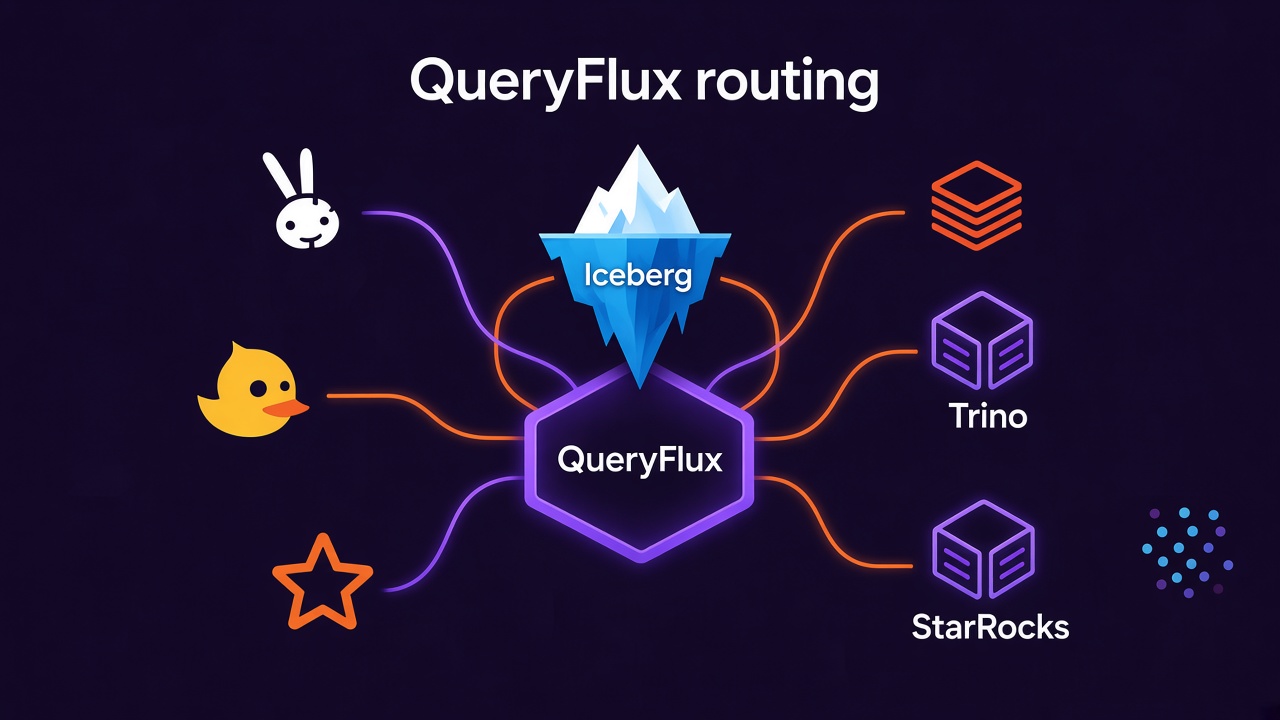
QueryFluxApache IcebergTrino
One Endpoint for Apache Iceberg on Trino and StarRocks
Run Trino and StarRocks on the same Iceberg tables behind one QueryFlux SQL endpoint — route BI and notebooks without client rewrites.

Data analytics on open lakehouses — query performance, BI integration, interactive exploration, and engine selection for analytical workloads.
16 articles
Run Trino and StarRocks on the same Iceberg tables behind one QueryFlux SQL endpoint — route BI and notebooks without client rewrites.

AI agents are eliminating the BI bottleneck — translating natural language to SQL in seconds, routing queries to optimal engines, and producing analyst-grade insights autonomously. Learn how to build a production analytics system on Iceberg with multi-engine routing, guardrails, and self-optimizing storage.

Query and write Apache Iceberg tables with DuckDB — no cluster required. Catalog setup, MERGE INTO, time travel, table layout, and when to route to DuckDB vs Spark or Trino.

Slow Iceberg queries almost always trace back to five structural problems: small files, wrong sort order, manifest bloat, stale snapshots, or partition misalignment. This diagnostic guide shows you how to find each one, confirm it with SQL, and fix it — manually or with autonomous optimization.

Slow Trino queries on Apache Iceberg are rarely a compute problem — they're a table layout problem. Unmaintained Iceberg tables turn sub-second Trino scans into minute-long full reads. This guide covers seven proven fixes for faster Trino Iceberg performance: compaction, query-aware sorting, partition strategy, manifest optimization, lifecycle cleanup, multi-engine routing, and continuous observability. Why Trino-native maintenance falls short — and how to automate each fix at scale.

How to choose, evaluate, and evolve partitioning strategies for Apache Iceberg tables — decision frameworks for real workloads, partition lifecycle management, and when to change your strategy.

Hot/cold data tiering on Apache Iceberg — StarRocks for sub-second dashboards, Iceberg for petabyte history, one SQL surface via federation. Ingestion, tier transitions, dedup, and keeping the cold tier fast.

Apache Iceberg query planning is the coordinator-bound bottleneck before any parallel scan starts. This guide covers predicate pushdown, manifest list pruning, file-level data skipping, and what data platform teams do to keep planning fast as tables grow.

Data quality and table health are different failure modes — one breaks business trust, the other breaks performance silently. A practical guide to the metrics, monitoring queries, classification frameworks, and automated remediation that keep Iceberg tables reliable in production.


Partitioning determines how much data every query must scan. Apache Iceberg's hidden partitioning and partition evolution change the game — but choosing the wrong strategy still creates performance cliffs. A practical guide to transforms, sizing, evolution, and avoiding the small-files trap.

Puffin files store table-level statistics — NDV sketches and custom blobs — that query engines use for join ordering, split planning, and cost-based optimization. A practical guide to how they work, how to collect them, how they go stale, and how to keep them accurate at scale.

A practical guide to optimizing Apache Iceberg queries and table maintenance with Trino — covering scan planning, predicate pushdown, file pruning, Trino-side tuning, maintenance procedures, physical layout optimization, and how a dedicated control plane eliminates JVM overhead while adding cross-engine intelligence.

Eight optimization layers for data platform engineers running BI, ad-hoc SQL, and aggregation pipelines on Apache Iceberg — from partition design and file sizing through compaction, routing, and continuous maintenance.


Iceberg tables degrade silently — small files from streaming, unsorted data, fragmented manifests, accumulated delete files. Each one caps query speed regardless of engine. Six concrete optimization layers, how they interact, and how autonomous maintenance keeps every table at peak performance.

Data lakes, warehouses, and lakehouses are not interchangeable — each has hard limits the others cannot cover. A practical guide for platform leaders: where each architecture wins, where it fails, cost and governance trade-offs, and how to choose (or combine) them in 2026.

QueryFlux is a universal SQL proxy and multi-engine query router in Rust—one access layer in front of Trino, DuckDB, StarRocks, and Athena with routing, dialect translation, and observability.