
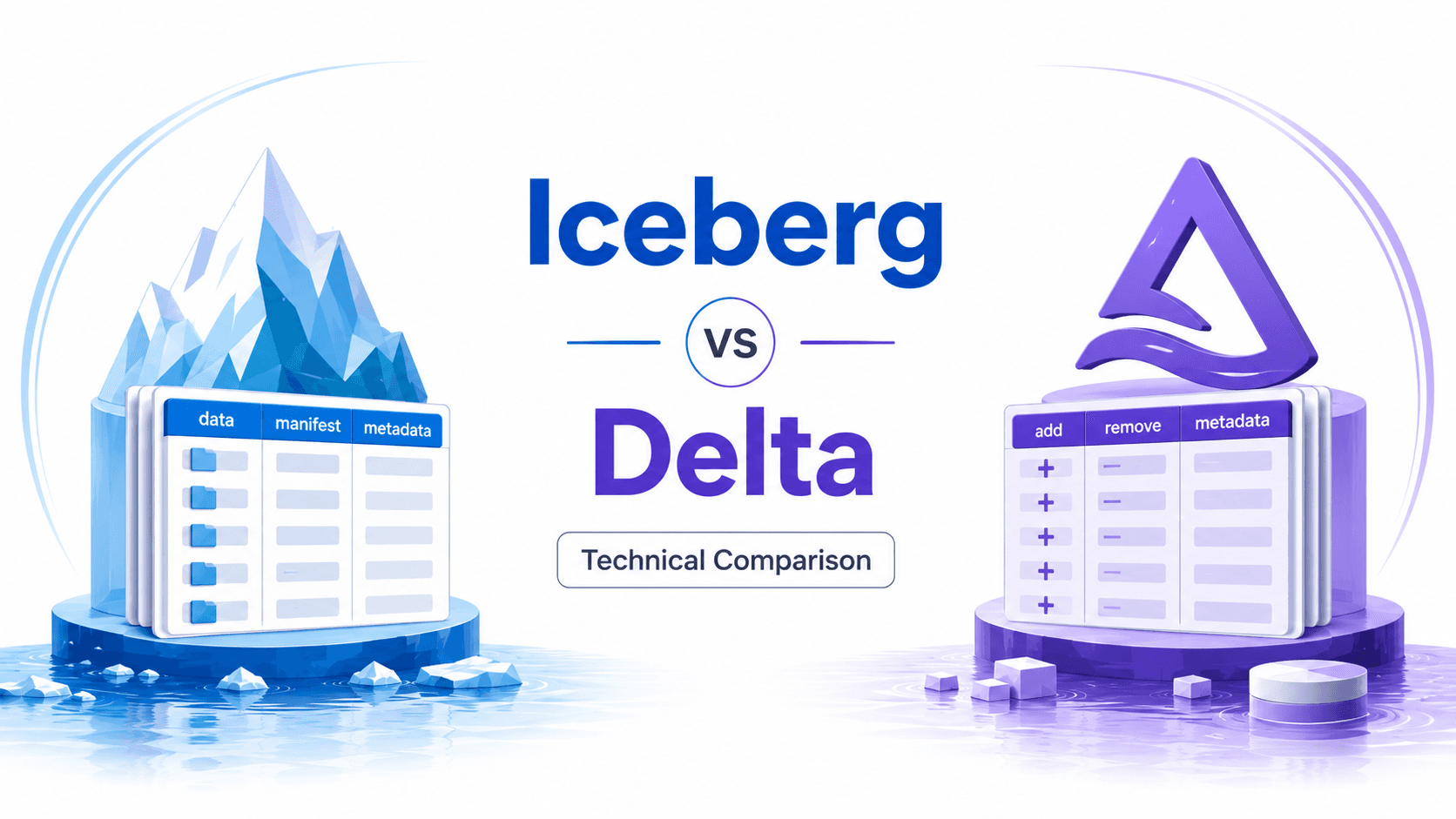
Apache Iceberg and Delta Lake are the two dominant open table formats in the lakehouse ecosystem. Both deliver ACID transactions, time travel, and schema evolution on top of object storage — but they make fundamentally different architectural choices about openness, engine independence, and operational responsibility.
This comparison is not about declaring a winner. Both formats are production-grade, widely adopted, and actively evolving. For teams already committed to migrating to Iceberg from other formats, the practical playbook covers the full journey. The real question is: which set of trade-offs fits your architecture? And once you've chosen, what operational infrastructure does your format require?
The short answer: Delta Lake excels as part of Databricks' vertically integrated stack — Auto-Optimize, Auto-Compact, Liquid Clustering, and Predictive Optimization are built into the platform, giving teams a self-optimizing lakehouse with minimal configuration. Apache Iceberg excels as the engine-neutral, catalog-neutral foundation for open architectures — but it deliberately separates format from operations, which means teams must build or adopt their own operational layer. For teams that choose Iceberg, LakeOps provides that layer: autonomous compaction, adaptive maintenance, query-aware optimization, and full observability across any engine and catalog.

Metadata architecture
The most fundamental difference between Iceberg and Delta Lake is how they track table state.
Delta Lake uses a transaction log — a sequence of JSON files (plus periodic Parquet checkpoints) stored in a _delta_log directory alongside the data. Each commit appends a new JSON file describing the actions performed: add file, remove file, change metadata, set transaction. To reconstruct table state, an engine replays the log from the last checkpoint forward. Delta Lake 4.0 introduced version checksums — compact summaries of log state that accelerate metadata parsing and provide integrity verification.
Apache Iceberg uses a tree-structured metadata hierarchy: a metadata file (JSON) points to a manifest list (Avro), which points to manifest files (Avro), which track individual data files with column-level statistics. Each snapshot captures the complete table state as an immutable pointer into this tree. There is no log replay — any engine can resolve the current table state by reading the metadata file referenced by the catalog.
The practical difference: Iceberg's metadata is self-contained and engine-independent. Any engine that can read JSON and Avro can understand an Iceberg table without importing a runtime library. Delta Lake's log requires understanding the action semantics — which is why Delta Kernel was introduced in Delta 4.0 as a lightweight library for non-Spark engines to read and write Delta tables correctly.
Iceberg's column-level statistics (min/max bounds, null counts, NaN counts) are stored per-file in the manifest. This enables fine-grained file pruning at plan time — engines skip files whose statistics prove they contain no matching rows. Delta Lake stores similar statistics in the transaction log's add actions, but Iceberg's manifest-level approach scales better for tables with thousands of partitions because manifest files can be pruned independently.
Schema evolution
Iceberg supports full schema evolution: add, drop, rename, and reorder columns — all as metadata-only operations that never require data rewriting. Each column is tracked by a unique field ID rather than by name or position, so renaming a column doesn't break existing data files. Historical data remains readable under the old schema via time travel. Type widening (e.g., int → long, float → double) is supported in Spec V3 without rewriting Parquet files.
Delta Lake supports adding columns, renaming columns (since Delta 3.0), dropping columns, and changing column types (with restrictions). Column mapping by ID was introduced to decouple physical Parquet column names from logical names, similar to Iceberg's approach. However, Delta's schema evolution historically required mergeSchema or overwriteSchema options during writes, making it more of a write-time concern than a pure metadata operation.
Both formats now support struct evolution (adding fields to nested types), but Iceberg's field-ID-based tracking makes complex nested schema changes more predictable across engines.
Partition evolution
This is where the two formats diverge most sharply in design philosophy.
Iceberg supports partition evolution natively — you can change the partition scheme of a table without rewriting existing data. Old data stays organized under the old partition spec; new data is written under the new spec. The query engine uses both partition specs transparently. For example, you can evolve from daily partitioning (days(event_time)) to hourly partitioning (hours(event_time)) as data volume grows, with zero downtime and no migration.
Delta Lake does not support partition evolution. Once a table is partitioned by a column, that choice is permanent unless you rewrite the entire table. Delta's answer to this rigidity is Liquid Clustering — which replaces partitioning entirely with a flexible, query-adaptive data layout. Rather than fix partition boundaries at table creation, Liquid Clustering organizes data using space-filling curves (Hilbert for multi-column, Z-order for single-column) and incrementally reclusters as data evolves.
Both approaches have merit. Iceberg preserves the partition concept but makes it mutable. Delta abandons partitions in favor of a continuously adaptive layout. For teams migrating from Hive-style partitioning, Iceberg's model is more familiar. For greenfield deployments where Databricks manages the lifecycle, Liquid Clustering is arguably simpler.

Hidden partitioning
Iceberg implements hidden partitioning — the physical partition layout is invisible to queries. Users write predicates against source columns (WHERE event_time > '2026-01-01'), and the engine automatically applies partition transforms (year, month, day, hour, truncate, bucket) to prune files. This eliminates an entire class of bugs where users forget partition filters or write incorrect path-based predicates.
Delta Lake does not have hidden partitioning in the traditional sense. With classic Delta partitioning, users must include partition columns in their predicates for pruning to activate. Liquid Clustering (available since Delta 3.0 and incremental since Runtime 2.0 / Delta 4.1) provides similar benefits — you specify clustering columns and the engine handles the physical layout — but it requires Databricks Runtime or compatible environments and is architecturally distinct from partition-based pruning.
Time travel and versioning
Both formats provide time travel, but with different mechanics.
Iceberg — each commit creates an immutable snapshot with a unique snapshot ID. Query any historical state by snapshot ID or timestamp. Snapshots form a chain; older ones can be expired to reclaim storage. Tags and branches (since Iceberg 1.2) provide named references to snapshots for compliance checkpoints and Write-Audit-Publish workflows.
Delta Lake — each commit increments a version number. Query by version or timestamp. The transaction log retains history based on logRetentionDuration (default 30 days). VACUUM removes data files no longer referenced by recent versions. Delta does not have a direct equivalent of Iceberg's branching and tagging, though time travel queries work similarly.
In practice, both deliver equivalent time travel capabilities for most use cases. Iceberg's explicit snapshot management (tags, branches, configurable retention) gives more granular control for compliance-heavy workloads.
Merge-on-read vs copy-on-write
Both formats now support merge-on-read (MoR) for row-level operations (UPDATE, DELETE, MERGE), but they arrived at it differently.
Iceberg V2 introduced positional delete files — separate Parquet files listing which rows in each data file are deleted. At read time, engines merge deletes with data. Iceberg V3 replaces positional deletes with deletion vectors — binary Roaring Bitmaps stored in Puffin files. Each data file can have at most one deletion vector per snapshot. The bitmap enables O(1) row-level lookup at read time (bit set = row deleted), versus the O(log n) sort-merge join required by V2 positional deletes. AWS benchmarks on EMR 7.11 confirm 10x faster DML versus copy-on-write and 55% faster delete operations versus V2.
Delta Lake has used deletion vectors since Delta 3.1. They use the same Roaring Bitmap format (and Iceberg V3 deliberately adopted binary compatibility with Delta's encoding). Delta also supports row-level change tracking via Row Tracking (introduced in Delta 4.0), which assigns stable row IDs that survive compaction — enabling efficient Change Data Feed without scanning entire files.
The formats have converged here. Both use deletion vectors with compatible binary encodings, both support merge-on-read, and both eventually compact accumulated deletes back into base files via periodic optimization.

Catalog independence
Iceberg defines an open REST Catalog specification that any vendor can implement. Production-ready catalog implementations include Apache Polaris (graduated to top-level Apache project in February 2026), AWS Glue (39% adoption per the 2025 Iceberg ecosystem survey), Project Nessie, Lakekeeper, and the Hive Metastore. Organizations can run multiple catalogs simultaneously or switch catalogs without migrating data. The catalog is a metadata service — it points to metadata files on object storage — not a data gateway.
Delta Lake centers on Unity Catalog, which is managed by Databricks. The Hive Metastore is also supported, and Delta 4.0 introduced catalog-managed tables as the new foundation for governance. Delta 4.3 routes all table operations through the Unity Catalog Delta APIs so the catalog validates every commit. Outside Databricks, catalog options are more limited — Hive Metastore works but lacks Unity's governance features (lineage, access control, data sharing).
Both approaches fit different architectures. Multi-cloud, multi-vendor deployments benefit from Iceberg's catalog neutrality. Databricks-centric deployments benefit from Unity Catalog's integrated governance, lineage, and access control — features that require significant effort to replicate with independent catalogs.
Engine support
This is where adoption patterns diverge most clearly.
Apache Iceberg has native, production-grade read/write support across: Apache Spark, Apache Flink, Trino/Presto, AWS Athena, Snowflake (native managed Iceberg tables since 2024), DuckDB, Dremio, StarRocks, ClickHouse, and Google BigQuery. The REST catalog API means any engine in any language can discover and interact with tables without importing a format-specific runtime. For a deeper look at how teams leverage this breadth, see Iceberg Multi-Engine Architecture.
Delta Lake has first-class support in Spark and Databricks (where it is the native format). Flink support has matured through Delta Kernel connectors. Trino has a Delta connector. Snowflake, Athena, and DuckDB can read Delta tables (DuckDB has limited write support). Where native Delta support is unavailable, UniForm bridges the gap by generating Iceberg and Hudi metadata alongside Delta commits — allowing any Iceberg-compatible engine to read Delta tables without data copying or format conversion.
The engine landscape in 2026: if your architecture includes Snowflake, Trino, Flink, and Spark all querying the same tables, Iceberg is the natural choice. If everything runs on Databricks, Delta is the native format with the deepest optimization.

Format interoperability: UniForm
Delta Lake 4.0 made UniForm generally available — a feature that synchronously generates Iceberg (and Hudi) metadata at commit time. This means a Delta table can be read by any Iceberg-compatible engine without data duplication. Delta 4.3 extended this with atomic, incremental conversion and IcebergCompatV3 support (enabling UniForm on tables with deletion vectors).
UniForm is a pragmatic interoperability solution: write Delta (with Databricks optimizations like Liquid Clustering and Predictive Optimization), read as Iceberg (from any Iceberg-compatible engine). This gives teams the best of both ecosystems — Delta's managed optimization on the write path, Iceberg's broad engine access on the read path. The trade-off is that writes still require Spark/Databricks, and some advanced Iceberg features (partition evolution, branching) aren't available on UniForm-generated metadata. For teams considering a full format transition instead, Delta Lake to Iceberg: Zero-Copy Migration covers the mechanics.
Iceberg achieves multi-engine access differently — through an open REST catalog protocol that any engine can implement natively. Both approaches solve the same problem (cross-engine access) with different trade-offs: UniForm is zero-effort for existing Delta users, while native Iceberg gives full feature access to all engines.
Community governance
Apache Iceberg is governed by the Apache Software Foundation with a diverse contributor base: Apple, Netflix, AWS, Snowflake, Dremio, Tabular (now Databricks), Cloudera, and dozens of others. No single company controls the roadmap. The specification is the contract — changes require community consensus through the ASF process.
Delta Lake is an open-source project under the Linux Foundation. The Delta protocol specification is open, the core libraries are Apache-licensed, and the project accepts external contributions. Databricks drives the majority of development, which means Delta benefits from coherent engineering vision and fast iteration — features like Liquid Clustering and UniForm shipped quickly because one team owned the full stack. The trade-off is that strategic direction is more concentrated than in a multi-stakeholder foundation.
Both governance models work. ASF stewardship provides maximum vendor diversity. A strong primary sponsor provides coherent direction and faster feature delivery. The choice depends on whether your organization prioritizes broad community control or rapid, opinionated evolution.
The operations gap: what both formats leave unsolved
Here's the key insight that comparison articles typically miss: choosing a table format is only half the architecture decision. The other half is operations.
A lakehouse in production needs continuous maintenance: compaction (merging small files), snapshot expiration (reclaiming storage), manifest rewriting (accelerating planning), orphan file cleanup (removing uncommitted data), and sort-order optimization (aligning physical layout with query patterns). For a detailed breakdown of how these operations interact, see Optimizing Iceberg Lakehouse Performance.
Delta Lake inside Databricks bundles these operations into the platform:
- Auto-Optimize / Auto-Compact — automatically compacts small files after writes
- Liquid Clustering — continuously reorganizes data layout based on clustering keys
- Predictive Optimization — analyzes workload patterns and runs OPTIMIZE, VACUUM, and ANALYZE automatically
- CLUSTER BY AUTO — uses query history to select optimal clustering keys without manual specification
This is genuinely powerful. Databricks users get a self-optimizing lakehouse without building operational infrastructure. The platform approach means those benefits are deepest within the Databricks ecosystem.
Apache Iceberg deliberately separates format from operations. The specification defines what a table is — not how to maintain it. This is architecturally correct (format specs shouldn't mandate operational tooling) but creates a real gap: teams adopting Iceberg must build or buy their own compaction pipelines, retention policies, monitoring, and optimization logic.
Most teams cobble together cron jobs calling rewrite_data_files, Airflow DAGs for snapshot expiration, and custom monitoring scripts. This works — until it doesn't. Tables drift into unhealthy states silently. Compaction runs at fixed intervals regardless of actual need. Sort orders are set once and never updated as query patterns evolve.

This is the operational fork in the road. Teams running Iceberg have two paths forward.
Head-to-head comparison table
| Dimension | Apache Iceberg | Delta Lake |
|---|---|---|
| Metadata | Tree-structured (metadata → manifest list → manifests → files) | Transaction log (JSON + Parquet checkpoints) |
| Schema evolution | Add, drop, rename, reorder — all metadata-only, field-ID tracking | Add, drop, rename, type change — column mapping by ID since 3.0 |
| Partition evolution | Native — change partition scheme without rewriting data | Not supported — use Liquid Clustering instead |
| Hidden partitioning | Yes — queries use source columns, engine applies transforms | No (Liquid Clustering provides analogous benefits) |
| Time travel | Snapshot-based, tags, branches, configurable retention | Version-based, log retention, VACUUM for cleanup |
| Deletion vectors | V3 — Roaring Bitmaps in Puffin files, O(1) lookup | Since 3.1 — compatible binary format, O(1) lookup |
| Catalog | REST spec, Polaris, Glue, Nessie, Lakekeeper, HMS | Unity Catalog, HMS, catalog-managed tables (4.0+) |
| Engine support | Spark, Flink, Trino, Athena, Snowflake, DuckDB, Dremio, BigQuery | Spark (native), Flink, Trino, DuckDB (limited), UniForm for Iceberg readers |
| Format interop | Native multi-engine access | UniForm generates Iceberg/Hudi metadata at commit |
| Operations layer | External (LakeOps, custom) | Built-in on Databricks (Auto-Optimize, Liquid Clustering, Predictive Optimization) |
| Governance | Apache Software Foundation, diverse contributors | Linux Foundation, Databricks-driven |
| Latest version | Spec V3 (deletion vectors, row lineage, Variant, geometry) | Delta 4.3 (UC Delta APIs, atomic UniForm, IcebergCompatV3) |
Path 1: Intelligent continuous optimization with LakeOps
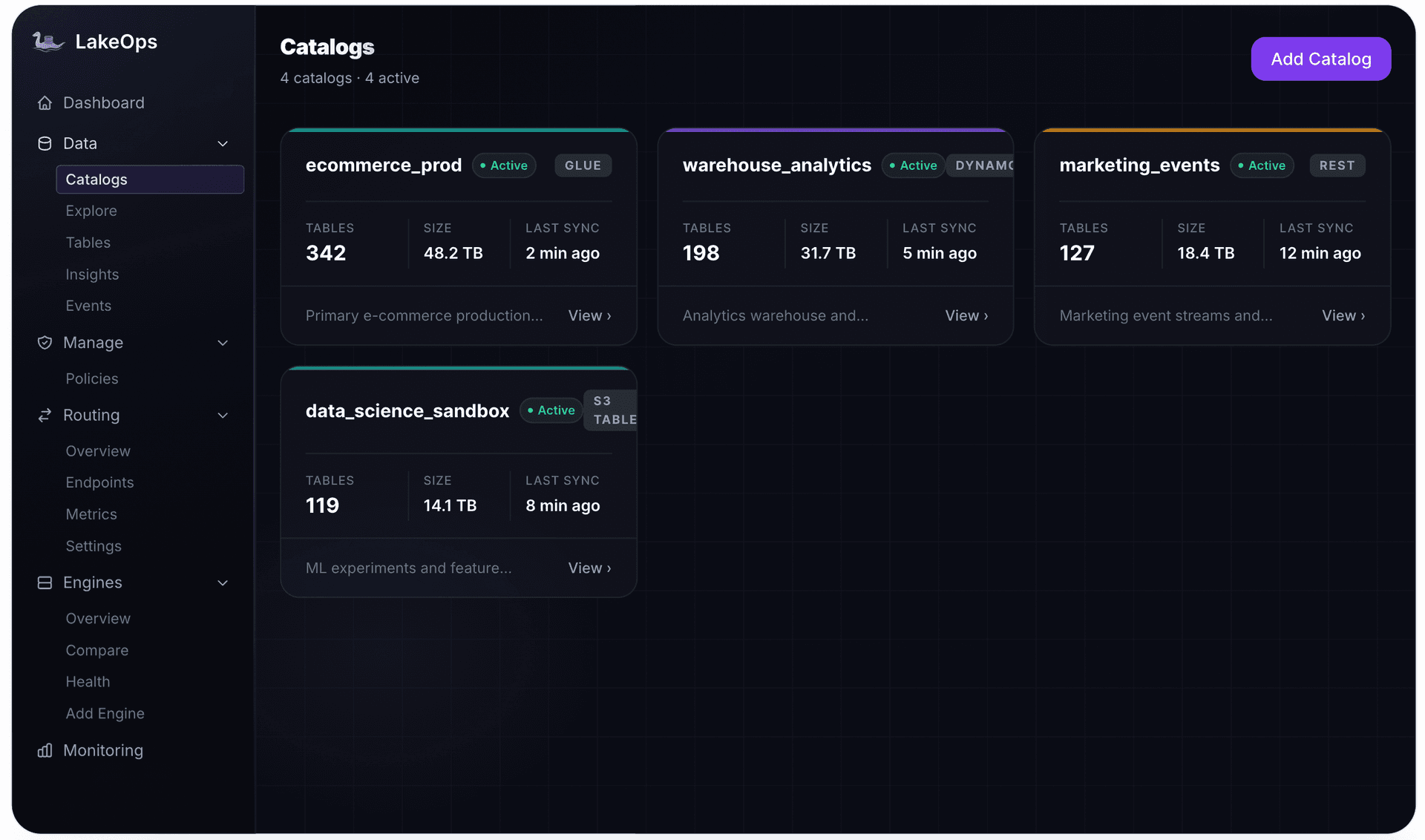
LakeOps is an autonomous control plane purpose-built for Apache Iceberg. It provides the operational layer that Databricks bundles for Delta — but for any Iceberg deployment, across any engine and any catalog. For a broader look at autonomous maintenance approaches, see Autonomous Iceberg Table Maintenance.
Compaction engine
LakeOps uses a Rust-based compaction engine built on Apache DataFusion. It processes compaction 95% faster than equivalent Spark jobs at approximately $5/TB versus $50/TB with Spark clusters. The engine reads Iceberg metadata, identifies fragmented files, and rewrites them with optimal sort order and target file sizes — without requiring a Spark cluster or JVM. For a deeper dive into compaction approaches, see Iceberg Compaction Strategies.
Query-aware sort order
Like Delta's Liquid Clustering and CLUSTER BY AUTO, LakeOps analyzes actual query patterns across all connected engines (Spark, Trino, Athena, Snowflake, DuckDB) and optimizes sort order to maximize file pruning for the most common predicates. Unlike Liquid Clustering, this works on any Iceberg table regardless of which engine wrote the data or which catalog manages it.
Multi-engine routing
LakeOps observes query patterns from every engine reading the table — not just Spark. A table queried primarily by Trino with time-range filters gets optimized differently than one queried by Athena with equality predicates on user_id. The control plane has visibility across the entire read path.
Adaptive maintenance
Rather than fixed schedules, LakeOps monitors table signals — commit frequency, file accumulation, snapshot velocity, query latency — and runs the right operations at the right time. Compaction triggers when fragmentation impacts query performance. Snapshot expiration runs when retention thresholds are crossed. Manifest rewrites execute when planning time degrades. Each operation enables the next in the correct sequence.

Organization-wide policies
Define maintenance rules at catalog, namespace, or table level. Streaming tables get aggressive compaction with short retention. Batch tables get weekly optimization with 30-day snapshots. Compliance tables get tagged checkpoints with multi-year retention. Policies cascade with inheritance and override — configure once, enforce continuously.

Observability and table health
Every table is classified by health status (Healthy, Warning, Critical) based on file count, average file size, snapshot accumulation, and manifest overhead. Issues are surfaced at four severity levels before they impact queries or costs. Full audit trails log every maintenance operation with before/after metrics.
Production results
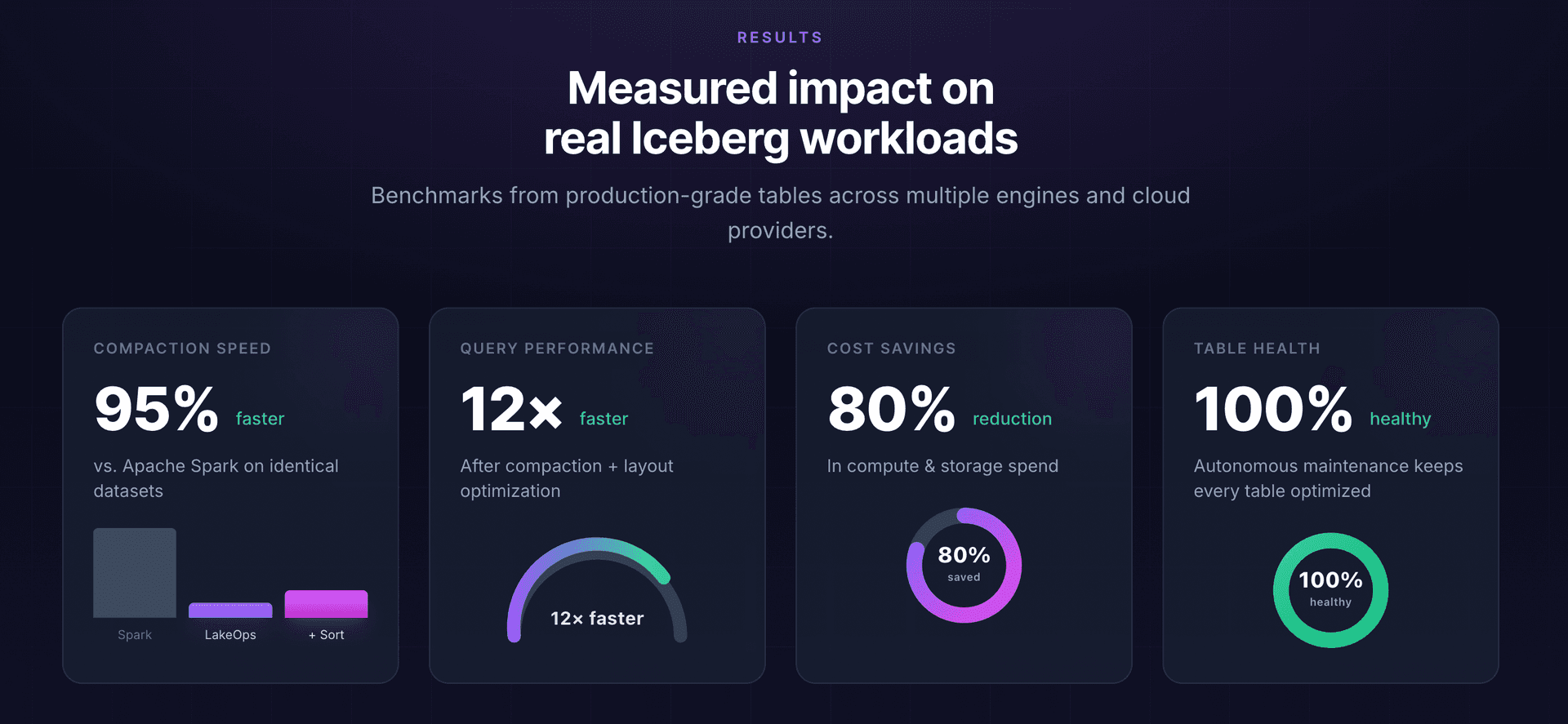
Teams running LakeOps in production report:
- 95% faster compaction — Rust/DataFusion engine vs Spark
- 12x faster queries — sort-order optimization aligned to actual query patterns
- 80% cost reduction — combined savings from storage reclamation, compute efficiency, and elimination of over-provisioned Spark clusters
Path 2: DIY operational management
Every operation LakeOps automates is achievable with SQL procedures, scheduling infrastructure, and custom monitoring. Here's what a self-managed Iceberg operations layer requires.
Compaction
1-- Bin-pack compaction2CALL system.rewrite_data_files(3 table => 'prod.db.events',4 strategy => 'binpack',5 options => map('target-file-size-bytes', '536870912')6);7 8-- Sort-order compaction (better query performance)9CALL system.rewrite_data_files(10 table => 'prod.db.events',11 strategy => 'sort',12 options => map(13 'sort-order', 'event_time ASC NULLS LAST, user_id ASC NULLS LAST',14 'target-file-size-bytes', '536870912'15 )16);Run on a schedule (Airflow, Step Functions, cron). The challenge: fixed schedules either run too often (wasting compute) or too rarely (degrading queries). You need monitoring to trigger compaction based on actual table state rather than wall-clock time.
Snapshot expiration
1CALL system.expire_snapshots(2 table => 'prod.db.events',3 older_than => TIMESTAMP '2026-07-26 00:00:00',4 retain_last => 105);Must run before orphan cleanup. Must respect active readers — expiring a snapshot that a running query depends on causes FileNotFoundException. In multi-engine environments, tracking which snapshots are in use across Spark, Trino, and Flink simultaneously requires cross-engine coordination that no built-in procedure provides.
Orphan file cleanup
1CALL system.remove_orphan_files(2 table => 'prod.db.events',3 older_than => TIMESTAMP '2026-07-23 00:00:00'4);Wait 72+ hours after expiration to avoid removing files from in-progress writes. Must run after snapshot expiration — running before misses newly-dereferenced files.
Manifest rewriting
1CALL system.rewrite_manifests('prod.db.events');Consolidates manifest files to reduce the number of files engines must read during query planning. Most impactful on tables with thousands of small manifests from frequent commits.
The DIY challenge
Each procedure is straightforward in isolation. The difficulty is orchestration at scale:
- Correct sequencing (expire → orphan cleanup → compact → manifest rewrite)
- Per-table scheduling based on workload characteristics
- Cross-engine reader awareness for safe expiration
- Sort-order selection based on actual query patterns (requires query log analysis)
- Monitoring table health across hundreds of tables
- Alerting when tables drift into unhealthy states
- Cost tracking and optimization
For 5 tables, this is manageable. For 500, it becomes a full-time engineering effort — which is exactly what a control plane automates.
When to choose Delta Lake
Delta Lake is the right choice when:
- Your compute runs primarily on Databricks or Microsoft Fabric
- You want a vertically-integrated platform where format, compute, governance, and operations are managed together
- Liquid Clustering's adaptive layout optimization eliminates your need for partition planning
- UniForm provides sufficient interoperability for occasional Iceberg-engine reads
- Unity Catalog's governance model (lineage, access control, data sharing) aligns with your requirements
- You prefer a single-vendor relationship with Databricks for support and roadmap alignment
When to choose Apache Iceberg
Apache Iceberg is the right choice when:
- Your architecture spans multiple engines (Spark + Trino + Snowflake + Athena + Flink)
- Vendor independence is a governance requirement
- You need partition evolution as data volumes and access patterns change
- Multiple teams use different tools to access shared tables
- You want catalog flexibility (Polaris, Glue, Nessie) without format lock-in
- Your data strategy spans multiple clouds or must remain portable
- You're willing to invest in operational tooling (or adopt a control plane like LakeOps)
Conclusion
The Iceberg vs Delta Lake decision in 2026 is less about raw capability — both formats are converging on feature parity for transactions, time travel, schema evolution, and deletion vectors — and more about ecosystem fit and operational philosophy.
Delta Lake excels as part of Databricks' vertically integrated platform. You get the format, the optimizer, the governance layer, and the operations layer in one package. Everything works together out of the box, with minimal operational configuration. The platform approach means those benefits are deepest within the Databricks ecosystem.
Apache Iceberg excels as the engine-neutral, catalog-neutral foundation for open lakehouse architectures. You get maximum portability, engine diversity, and architectural flexibility. The trade-off is operational responsibility: without a platform bundling maintenance, someone must manage compaction, retention, and monitoring — either through custom tooling or a dedicated control plane.
For teams choosing Iceberg, LakeOps provides the operational parity that Databricks bundles for Delta — autonomous compaction, query-aware sort optimization, adaptive maintenance, organization-wide policies, and full observability — without surrendering the engine independence that made Iceberg the right choice in the first place.
Both formats are excellent. The best choice depends on your ecosystem. For Iceberg-bound teams, the migration solutions guide covers the end-to-end transition. And whichever format you choose, investing in the operations layer — whether bundled in a platform or provided by a control plane — is what separates production lakehouses from ones that silently degrade.
---
Further reading:
- Iceberg Partitioning Best Practices — layout strategies that differentiate Iceberg
- Iceberg Puffin Statistics Guide — column statistics unique to Iceberg
- Iceberg Delete Files & Merge-on-Read — Iceberg's row-level delete approach