Data Lakehouse
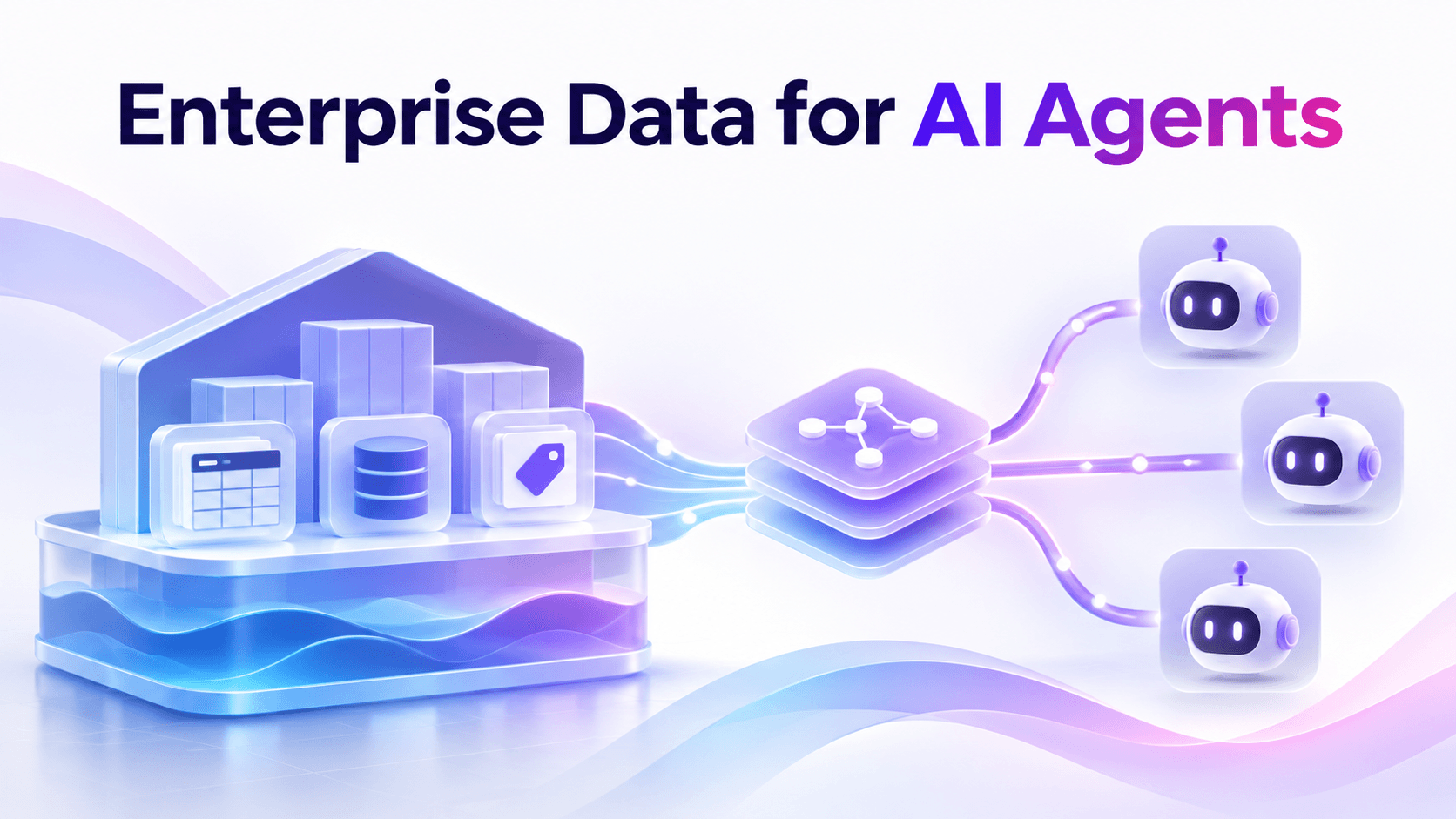
Enterprise Data for AI Agents: A Guide
How to make an Iceberg lakehouse ready for AI agents: intelligence in the operations loop, agents that query safely and efficiently, and agents that help maintain the lake over MCP.
Agentic Lakehouse
On the Iceberg lake you already run: intelligence runs the lakehouse, AI agents get safe, optimized access to its data, and agentic operations run over MCP.
 LakeOps
| Operation | Table | Duration | Impact | Time | Status |
|---|---|---|---|---|---|
| Compact Data Files | customer_orders orders | 4s | 1.24 TB, 16 → 1 files | 57 minutes ago | SUCCESS |
| Expire Snapshots | payment_transactions payments | 27s | 8.2 TB | 4 hours ago | SUCCESS |
| Expire Snapshots | inventory_snapshots_20250702 warehouse | 3s | 2.1 TB | 4 hours ago | SUCCESS |
| Rewrite Manifests | raw_clickstream analytics | 1.9s | 3 → 1 manifests | 5 hours ago | SUCCESS |
| Compact Data Files | product_catalog products | 6m 11.3s | 3,008 → 1,256 files | 6 hours ago | SUCCESS |
Open and runs on your stack












Agentic lakehouse
Intelligence runs the lakehouse, AI agents get safe, optimized access to its data, and agentic operations run over MCP.
Reads Small files, deletes, snapshots
Reads SQL shape, client, engine load
Reads Which agent, which SQL
Reads Catalogs, namespaces, insights
Reads Tables, filters, row counts
Reads Row filters, column masks
Reads Queues, health, cache
Reads Which agent, which conversation
Reads Critical and warning tables
Reads Why tables are flagged, what's due
Reads Policy coverage and gaps
Reads What ran, and how it went
Reads table signals
Decides what runs, in order
01 · Intelligence
View and track table operations and history
| Table Name | Namespace | Catalog | Operation Type | Impact | Duration | Start Time | Status |
|---|---|---|---|---|---|---|---|
| customer_orders | orders | ecommerce_prod | Compact Data Files | 1.24 TB, 16 → 1 files | 4s | 57 min ago | SUCCESS |
| customer_orders | orders | ecommerce_prod | Compact Data Files | 11 → 8 files | 10.3s | 2h ago | SUCCESS |
| customer_orders | orders | ecommerce_prod | Compact Data Files | 970 → 87 files | 6m 1.0s | 3h ago | SUCCESS |
| payment_transactions | payments | ecommerce_prod | Expire Snapshots | 1 snapshot | 4.6s | 4h ago | SUCCESS |
| payment_transactions | payments | ecommerce_prod | Rewrite Manifests | 3 → 1 manifests | 1.9s | 4h ago | SUCCESS |
| raw_clickstream | analytics | marketing_events | Compact Data Files | 970 → 87 files | 9m 31.6s | 5h ago | SUCCESS |
| user_sessions | analytics | marketing_events | Remove Orphan Files | 1,203 files, 847 MB | 1m 12s | 5h ago | SUCCESS |
| product_catalog | products | ecommerce_prod | Compact Data Files | 3,008 → 1,256 files | 6m 11.3s | 6h ago | SUCCESS |
| user_sessions | analytics | marketing_events | Rewrite Manifests | 2 → 1 manifests | 1.8s | 7h ago | SUCCESS |
| inventory_levels | operations | warehouse_analytics | Remove Orphan Files | 4,218 files, 1.9 GB | 3m 44s | 7h ago | SUCCESS |
| inventory_levels | operations | warehouse_analytics | Expire Snapshots | 12 snapshots expired | 2.0s | 8h ago | SUCCESS |
| shipping_events | logistics | warehouse_analytics | Rewrite Manifests | 3 → 1 manifests | 1.0s | 8h ago | SUCCESS |
01 · Every run on record
Attempt 1
denySELECT * FROM fct_ordersrequire_predicate: add a WHERE filter on order_date to query fct_orders.
Attempt 2
allowSELECT order_id, customer_email, status
FROM fct_orders
WHERE order_date >= DATE '2026-11-01'
LIMIT 10002 · Agent access
Each query to the engine your rules pick
Tables kept fast underneath
02 · Cost and speed
3
Critical
12
Warning
1,184
Healthy
Fix first
sales.orders: excessive snapshots, because a branch has no retention.
events.clicks: partitions of mostly small files; compaction is due.
Reclaimable storage on 9 tables. 5 namespaces have no snapshot retention policy.
03 · Agentic ops
03 · Scoped actions
LakeOps reads your Iceberg metadata. Data stays in your storage.
Every table's health and what it needs, from the first scan.
Autopilot, on-demand runs, or your own policies.
The challenge
Agents query all day, explore wide, and act on what they read. Cron jobs, shared credentials, and one big cluster don't hold up.
Scheduled jobs run too late for busy tables and waste compute on quiet ones. Agents query around the clock, so a degraded table has no quiet window to hide in.
Agents get a warehouse credential. Nothing checks their SQL before it runs, and every query looks like the same user.
Agents scan wide, retry, and repeat themselves on the same expensive cluster your dashboards use, with no cap on how much they run at once.
When a table degrades, an agent can't say why or fix it safely. Triage still waits for a person, a notebook, and a Spark job.
Compare
Scripts leave the work to you, and engine-centric platforms move your queries to them. LakeOps and QueryFlux bring all three ways to the Iceberg lake you already run.
| Capability | Scripts and shared keys | Engine-centric AI platform | LakeOps + QueryFlux |
|---|---|---|---|
| Intelligence runs the lakehouse | Cron jobs and Spark scripts you maintain | Often limited to tables in its own catalog | Run on each table's signals, across your Glue and REST catalogs |
| Safe, optimized agent access | A shared warehouse credential | Through its own engine | One governed endpoint, over MCP or SQL drivers, across the engines you run |
| Guardrails | None | The engine's permissions | Read-only, row limits, required filters, row filters and column masks, custom guards |
| Agent query cost | One cluster for everything | Its own compute | Routing rules, cache, and a concurrency cap per group |
| Agentic operations over MCP | Not covered | Mostly queries and analytics | Health, triage, maintenance, and policies over MCP, within each key's scopes |
| Your stack | Unchanged, plus scripts to own | Queries move to its engine | Catalogs and engines stay; data never moves |
Engine-centric AI platforms vary by vendor; details are from public documentation, November 2026.
Results
Benchmarks from production-grade tables across multiple engines and clouds.
Query speed
After compaction + layout optimization
CPU reduction
Compute hours across all engines
Storage saved
Orphans, snapshots & bloat removed
Table health
Autonomous maintenance keeps every table optimized
See it in action
The intelligence that runs the lake, across your catalogs.
FAQ
A lakehouse where AI and your data work together, with AI agents as first-class users. With LakeOps on Apache Iceberg that happens in three ways: intelligence runs the lakehouse, so maintenance follows each table's signals; agents get safe, optimized access to its data through governed, cost-aware SQL; and agentic operations run over MCP, within the scopes you grant.
No. LakeOps connects to AWS Glue or any Iceberg REST catalog, such as Apache Polaris or Project Nessie, reads Iceberg metadata, and maintains tables in place in your bucket. Your engines keep reading the same tables, and agent queries run on engines you already operate.
LakeOps scans each table's metadata, raises insights by severity, and sets its health. Adaptive Maintenance then runs compaction, snapshot expiry, position delete rewrites, dangling delete removal, and manifest rewrites, in that order, only when each one is due. Orphan cleanup is its own policy, and every operation is recorded in Events.
Through QueryFlux, the open-source SQL gateway behind LakeOps routing. Agents connect over MCP or a PostgreSQL, MySQL, or Trino driver. Guardrails check each query before an engine sees it, OPA or Cerbos policies add row filters and column masks, and routing sends the query to the engine your rules pick, serves repeats from cache, and caps how many agent queries run at once.
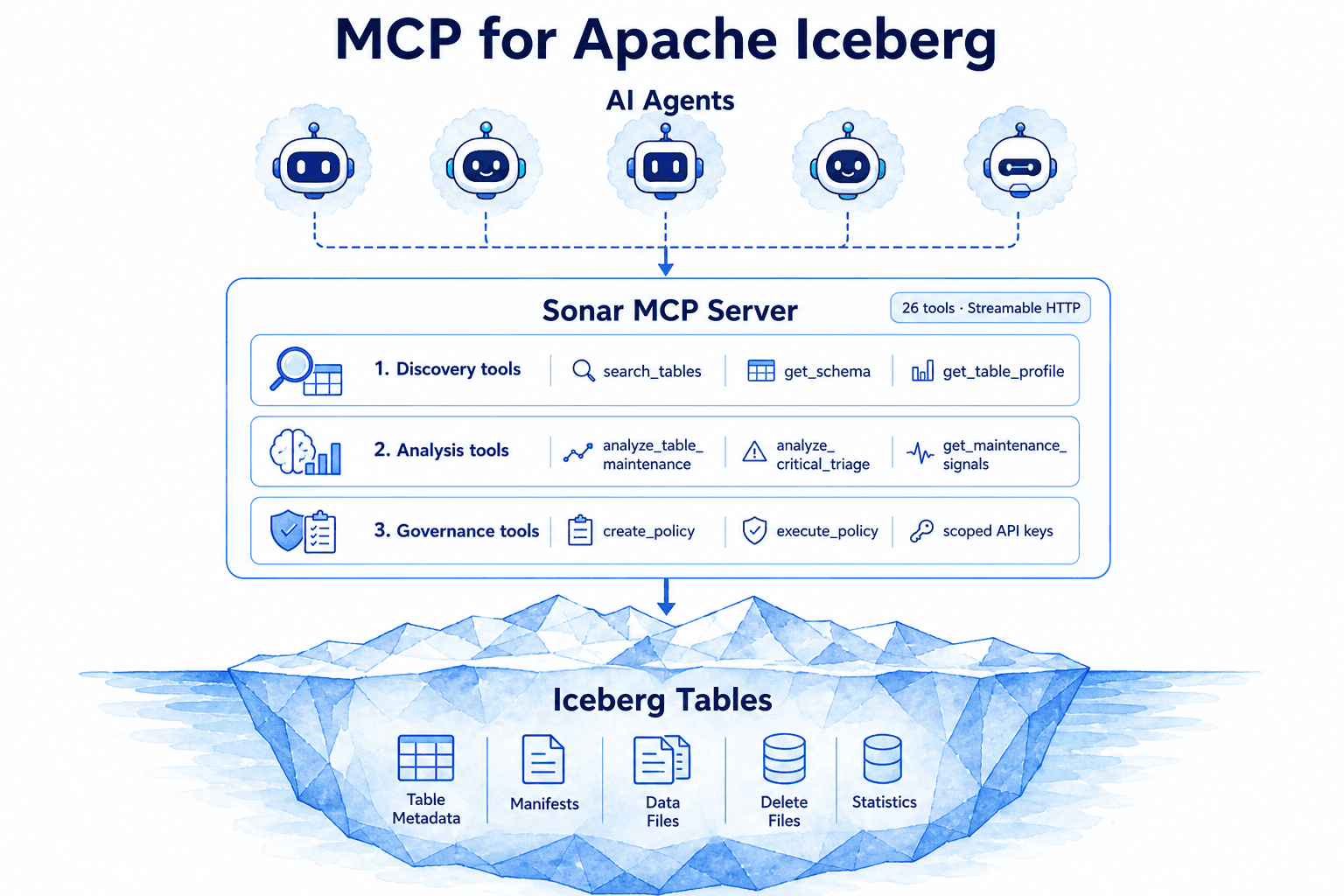
Within limits you set, yes. Each agent uses its own organization API key, and the server checks the key's scopes on every tool call. Start with a read key for triage and reports, then grant policies:write or tables:write per agent. Destructive tools carry a hint so clients that honor it ask before running them, and every operation lands in Events.
For operations: Claude Code, Claude Desktop, Cursor, and any client that supports MCP over Streamable HTTP, through the LakeOps MCP server in your region. For queries: any MCP client through QueryFlux, or any tool that speaks the PostgreSQL, MySQL, Trino HTTP, or Arrow Flight SQL protocol.
No. Each works on its own, and each builds on the one before. A common path: let intelligence run the tables agents will read first, then put agent access behind the gateway, then add agentic operations over MCP with read-only keys.
Related
Resources
Connect a catalog, then add governed agent access and operator agents when you're ready.