





Managed Iceberg in 2026: Autonomous Data Lake
Iceberg tables degrade silently — small files pile up, snapshots bloat metadata, and query latency creeps higher. A breakdown of the nine components every production data lake needs to stay healthy.
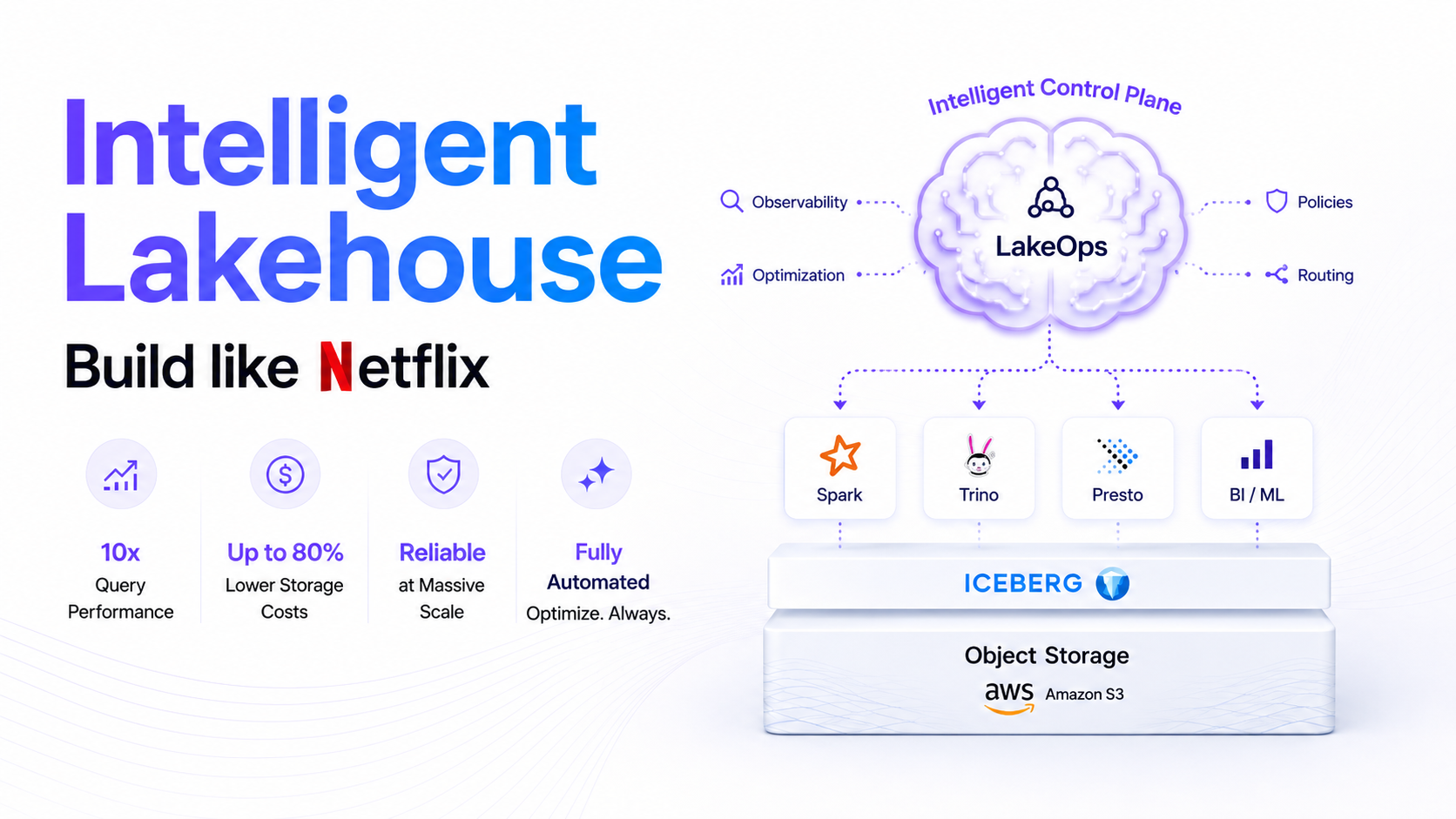
Cut costs and accelerate queries with autonomous management across your data and engines—with built-in agentic AI support.

Runs on your stack
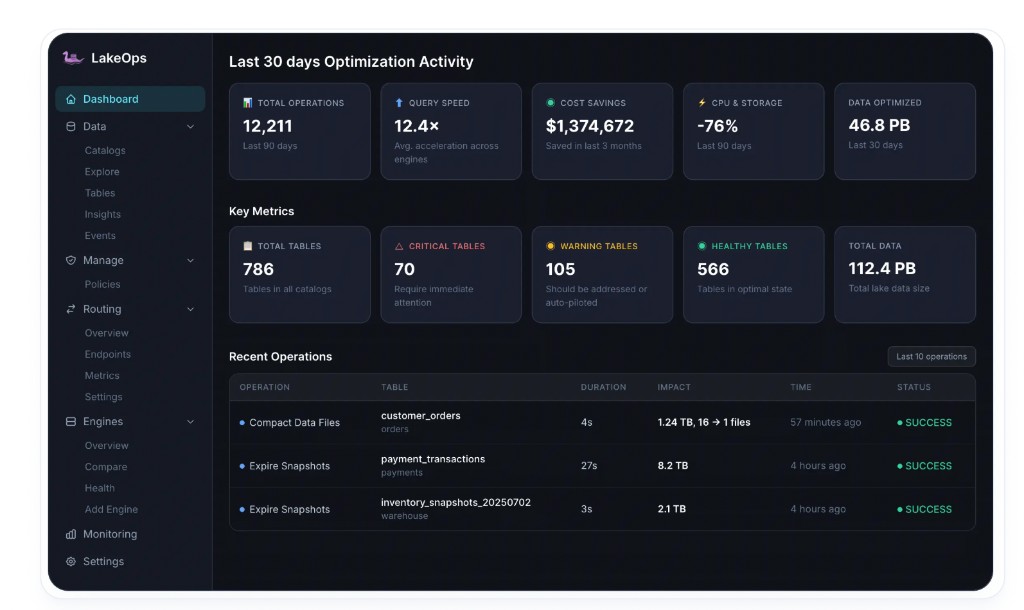
| Operation | Table | Duration | Impact | Time | Status |
|---|---|---|---|---|---|
| Compact Data Files | customer_orders orders | 4s | 1.24 TB, 16 → 1 files | 57 minutes ago | SUCCESS |
| Expire Snapshots | payment_transactions payments | 27s | 8.2 TB | 4 hours ago | SUCCESS |
| Expire Snapshots | inventory_snapshots_20250702 warehouse | 3s | 2.1 TB | 4 hours ago | SUCCESS |
| Rewrite Manifests | raw_clickstream analytics | 1.9s | 3 → 1 manifests | 5 hours ago | SUCCESS |
| Compact Data Files | product_catalog products | 6m 11.3s | 3,008 → 1,256 files | 6 hours ago | SUCCESS |
Lakehouse Control Plane
End-to-end optimization for every table op, across storage and engines. Telemetry-driven smart orchestration with full visibility and control.
A unified control plane that understands your lake end-to-end — tables, engines, queries, and costs — and acts on it autonomously.
Read articleSnapshot expiration, manifest rewrites, orphan cleanup, and metadata — automated, scheduled, and safe.
Explore maintenanceRust-based engine that organizes data by real query patterns — every cycle cuts IO, shrinks file counts, and speeds up reads.
Explore compactionRoute queries across Trino, Spark, Snowflake, and more — optimized for cost, latency, or throughput per workload.
Explore routingAgent-native MCP interface, guardrails, and a self-optimizing lake ready for AI agents, feature stores, and autonomous pipelines.
Explore AI enablementTable health, engine metrics, cross-system telemetry, and policy-driven governance from one control plane.
Explore observabilityResults
Benchmarks from production-grade tables across multiple engines and cloud providers.
Compaction speed
vs. Apache Spark on identical datasets
Query performance
After compaction + layout optimization
Cost savings
In compute & storage spend
Table health
Autonomous maintenance keeps every table optimized
SOC 2, SSO, RBAC, dedicated support, and the scale your largest Iceberg lakes demand.
SOC 2 Type II, encryption, SSO/RBAC, and audit trails for regulated teams.
One control plane for your full lake. Real-time visibility, policies, and predictable performance.
Dedicated onboarding, training, and enterprise SLAs. Deploy in VPC or on-prem.
LakeOps took the pain out of compaction and maintenance. We went from ad-hoc scripts and firefighting to a single control plane. Query performance improved and our platform team finally has visibility across the lake.

We evaluated several options for Iceberg operations. LakeOps stood out for its focus on automation and multi-engine support. Deployment was straightforward and the impact on cost and latency was measurable within weeks.

Our tables were suffering from small files and fragmented metadata. LakeOps runs continuously in the background—we set policies once and the system handles the rest. Maintenance automation that actually works.


Iceberg tables degrade silently — small files pile up, snapshots bloat metadata, and query latency creeps higher. A breakdown of the nine components every production data lake needs to stay healthy.

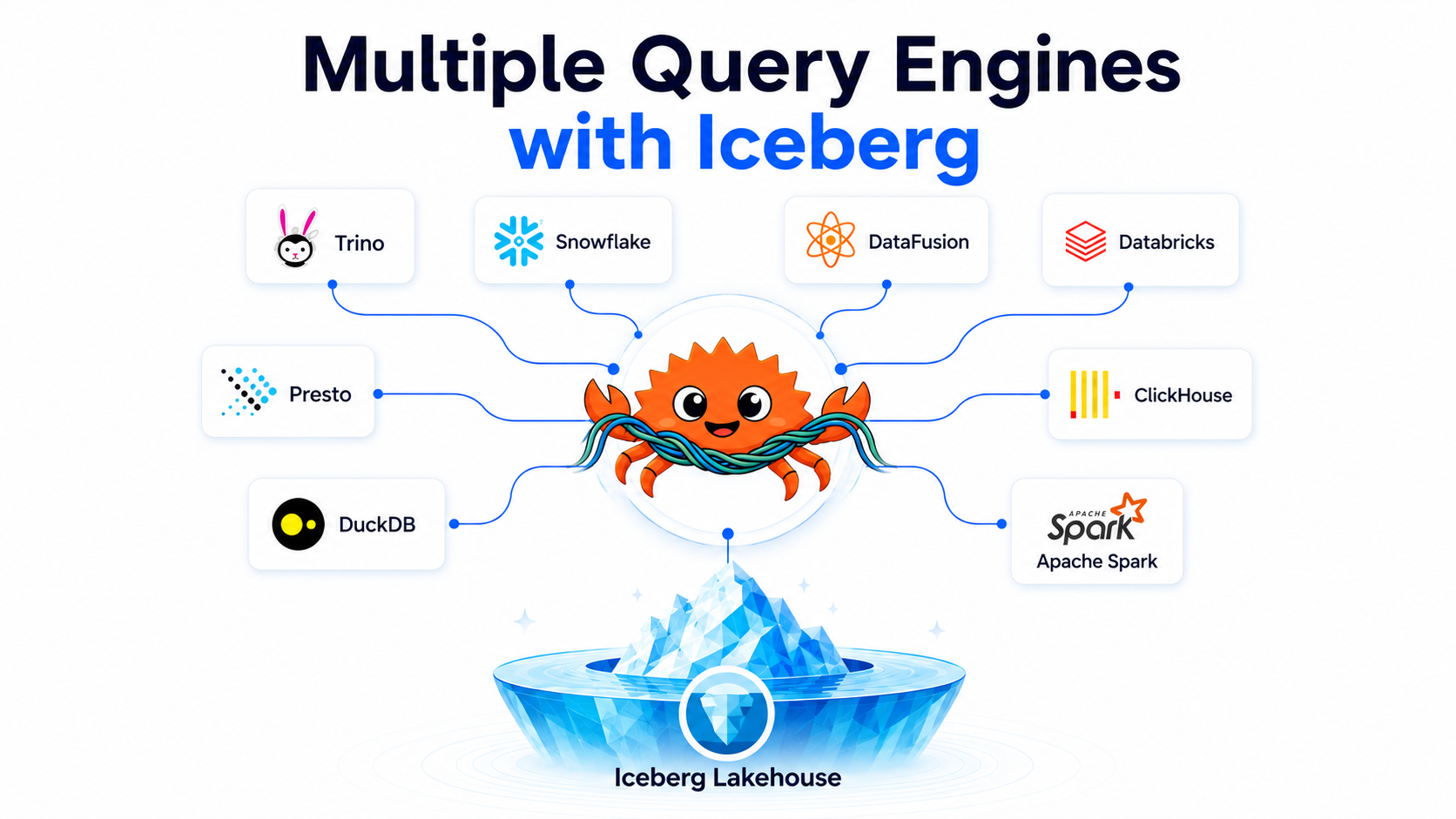
Netflix spent years building an intelligent lakehouse — Polaris, Autotune, janitors, and Metacat. LakeOps lets every team build the same — and go beyond — in minutes.

How to route queries across Trino, Spark, DuckDB, Snowflake, Athena, and Flink on shared Iceberg tables — SQL routing proxy, dialect translation, and table-aware optimization.
Make Your Lakehouse Powerful
Get a personalized walkthrough of the LakeOps platform with your data. Short call, your architecture.
No commitment · Typically 30 min