

Iceberg Lake Observability
Know everything.
Control your Lakehouse.
LakeOps unifies Iceberg metadata, table health, proactive insights, and cross-engine query telemetry in one control plane — so platform teams know which tables are degrading, why, and what to do next.
 LakeOps
Last 30 days Optimization Activity
Key Metrics
Recent Operations
| Operation | Table | Duration | Impact | Time | Status |
|---|---|---|---|---|---|
| Compact Data Files | customer_orders orders | 4s | 1.24 TB, 16 → 1 files | 57 minutes ago | SUCCESS |
| Expire Snapshots | payment_transactions payments | 27s | 8.2 TB | 4 hours ago | SUCCESS |
| Expire Snapshots | inventory_snapshots_20250702 warehouse | 3s | 2.1 TB | 4 hours ago | SUCCESS |
| Rewrite Manifests | raw_clickstream analytics | 1.9s | 3 → 1 manifests | 5 hours ago | SUCCESS |
| Compact Data Files | product_catalog products | 6m 11.3s | 3,008 → 1,256 files | 6 hours ago | SUCCESS |
Telemetry from across your stack











In the product
Full lake visibilitywith one-click actions
From executive health summary to per-table metrics and engine telemetry — each layer answers a different question platform teams ask every day.
Lake-wide dashboard
One screen for the health of your entire lake
After catalogs connect, LakeOps discovers every table and reads Iceberg metadata continuously. The dashboard summarizes health tiers, active insights, and lake scope — so platform teams start triage without writing SQL.
- Critical, Warning, and Healthy counts across all connected catalogs
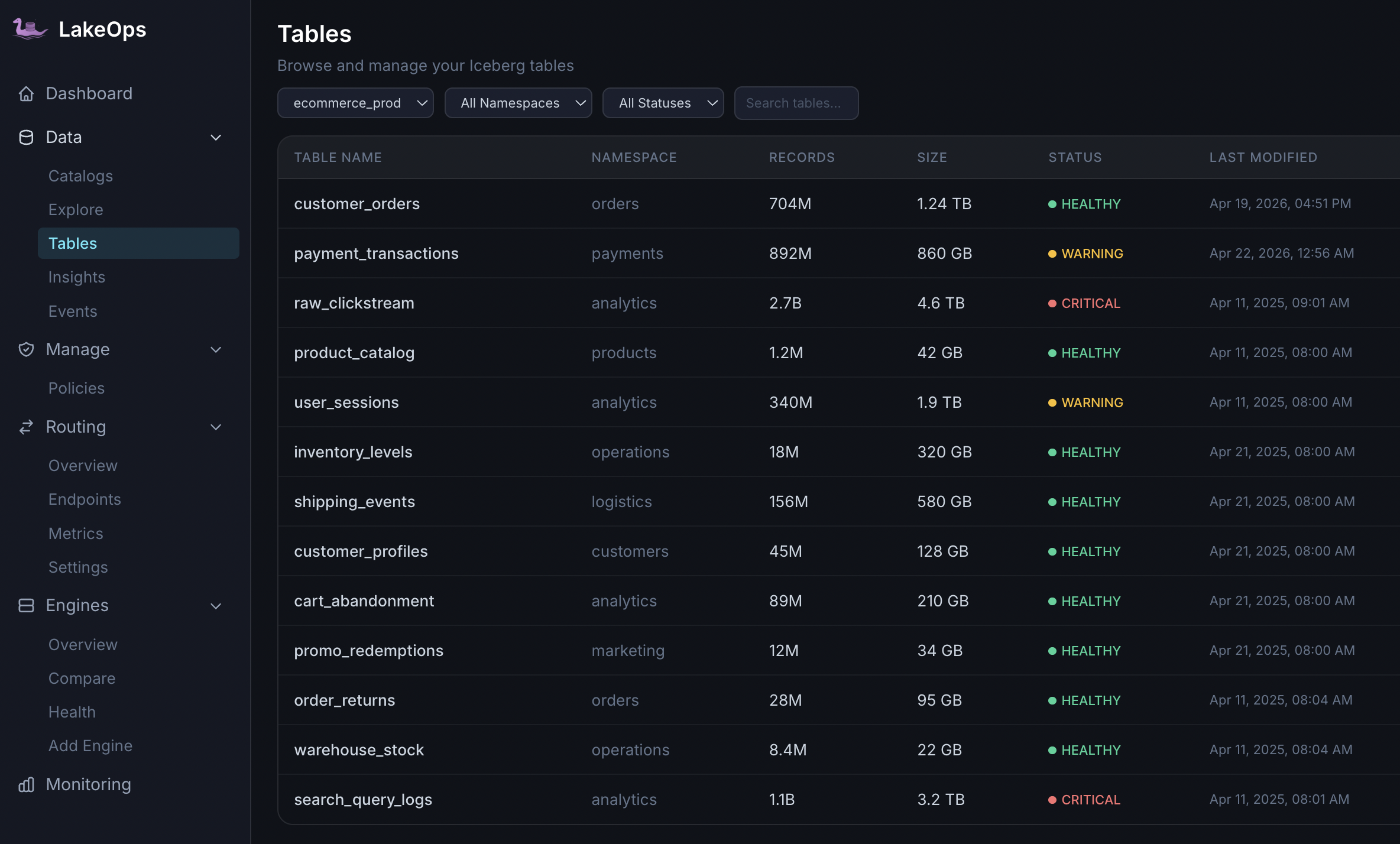
- Table inventory with records, size, status, and last-modified at a glance
- Refreshes as schemas and namespaces evolve — no custom instrumentation
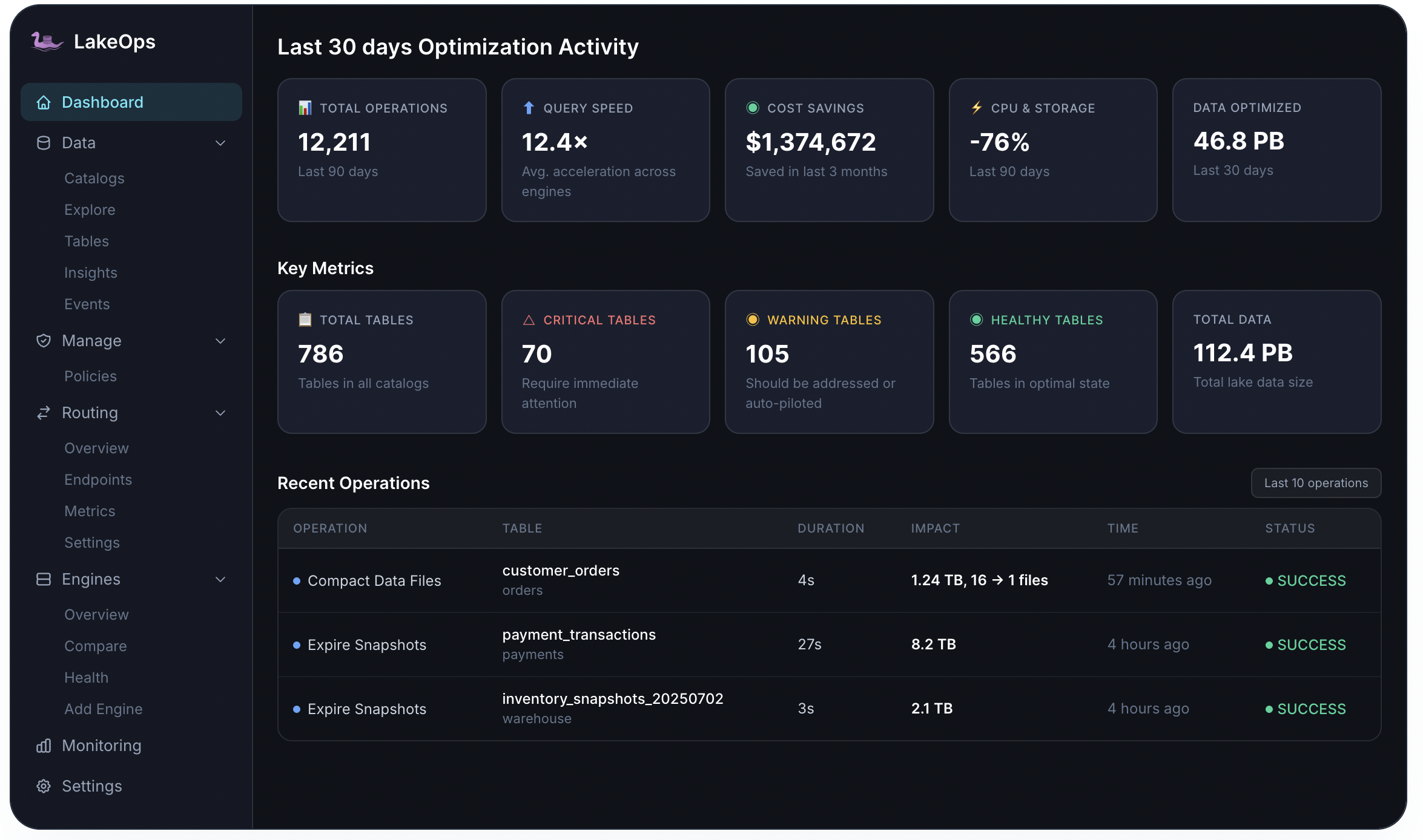
Table health classification
Structural scoring for every registered table
Health is computed from Iceberg signals teams already care about: file count and size distribution, manifest depth, snapshot accumulation, delete-file ratio, partition skew, and sort-order alignment with real query patterns.
- Critical — severe fragmentation or metadata bloat; planning or scans at risk
- Warning — degradation underway; likely to reach Critical without action
- Healthy — structural indicators within bounds you define per environment
Events & audit trail
Complete history of what changed and why
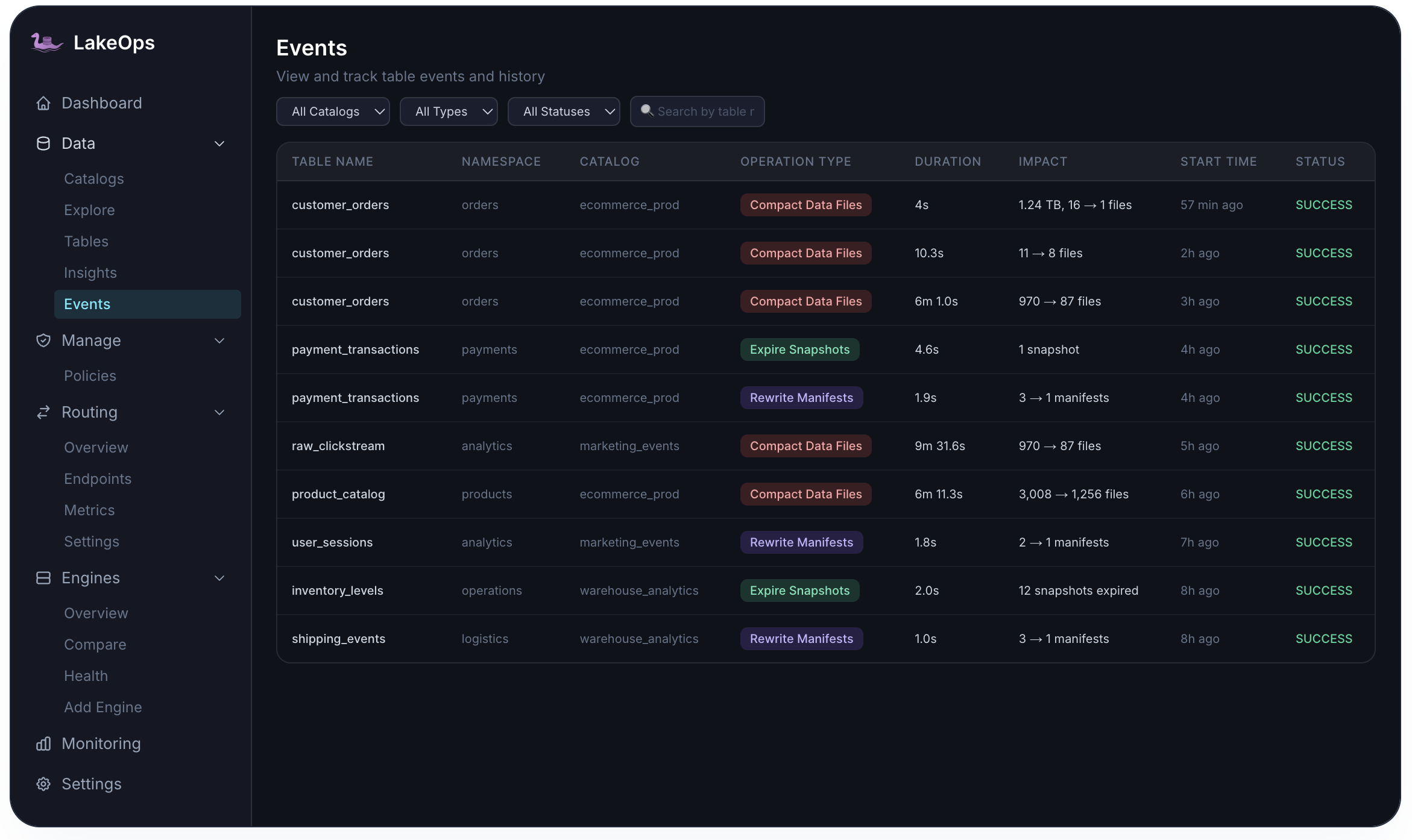
Every maintenance operation — compaction, expiration, orphan removal, manifest rewrite — is logged lake-wide and per table with duration, impact, and status. Observability closes the loop: see the problem, act, verify the outcome.
- Filter by catalog, operation type, and success or failure
- Before/after file and manifest counts on every event
- Compliance-ready trail for platform and data-governance teams
Actionable insights
Actionable alerts before users file tickets
Insights evaluate tables on a schedule and raise prioritized findings — each tied to a table, severity, and recommended next step. Remediate manually or let policies act on the same signal.
- CRITICAL — partition file explosions and runaway write patterns
- HIGH — manifest counts above threshold, snapshot backlog
- WARNING — partition skew, emerging small-file clusters
- LOW — early drift you can fix before the next compaction window
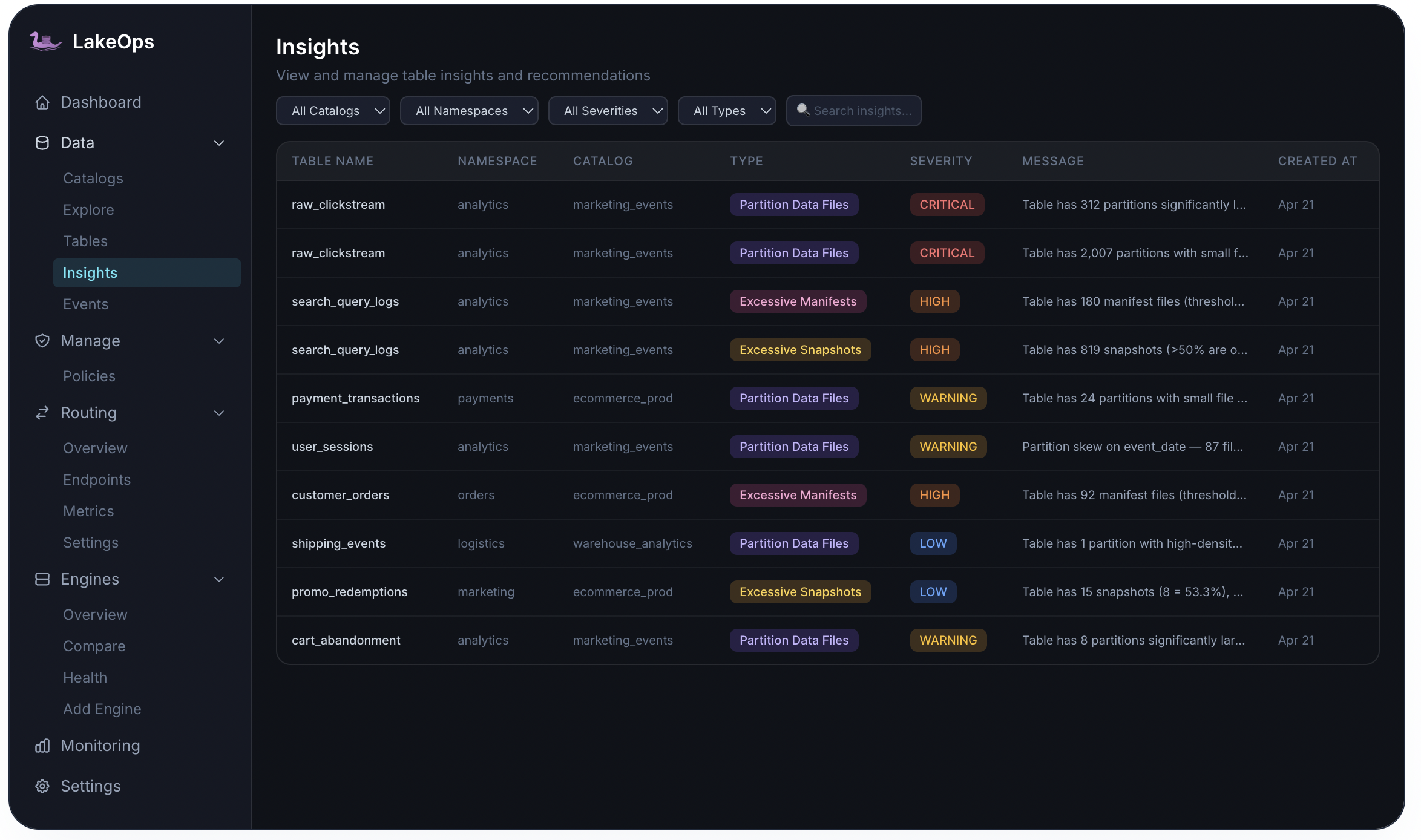
Table-level insights
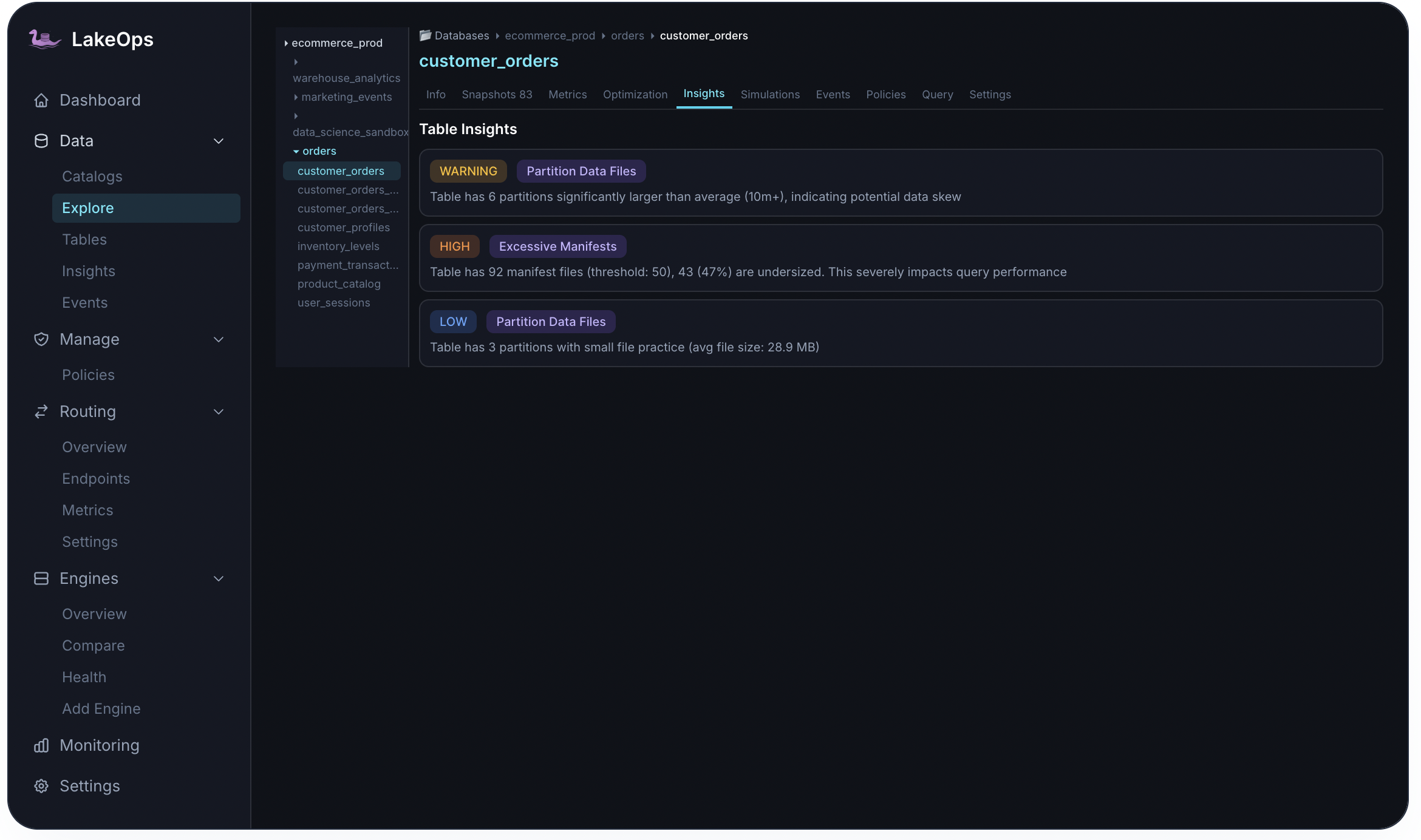
Drill into the signals driving each table's health
Beyond lake-wide alerts, every table surfaces its own insights — manifest count vs. threshold, partition skew, small-file accumulation, and more. Each finding links directly to the affected table with severity and recommended action.
- Per-table severity breakdown — from CRITICAL to LOW
- Manifest fragmentation alerts with undersized-file counts
- Partition skew and small-file warnings before they compound
Explore & metrics
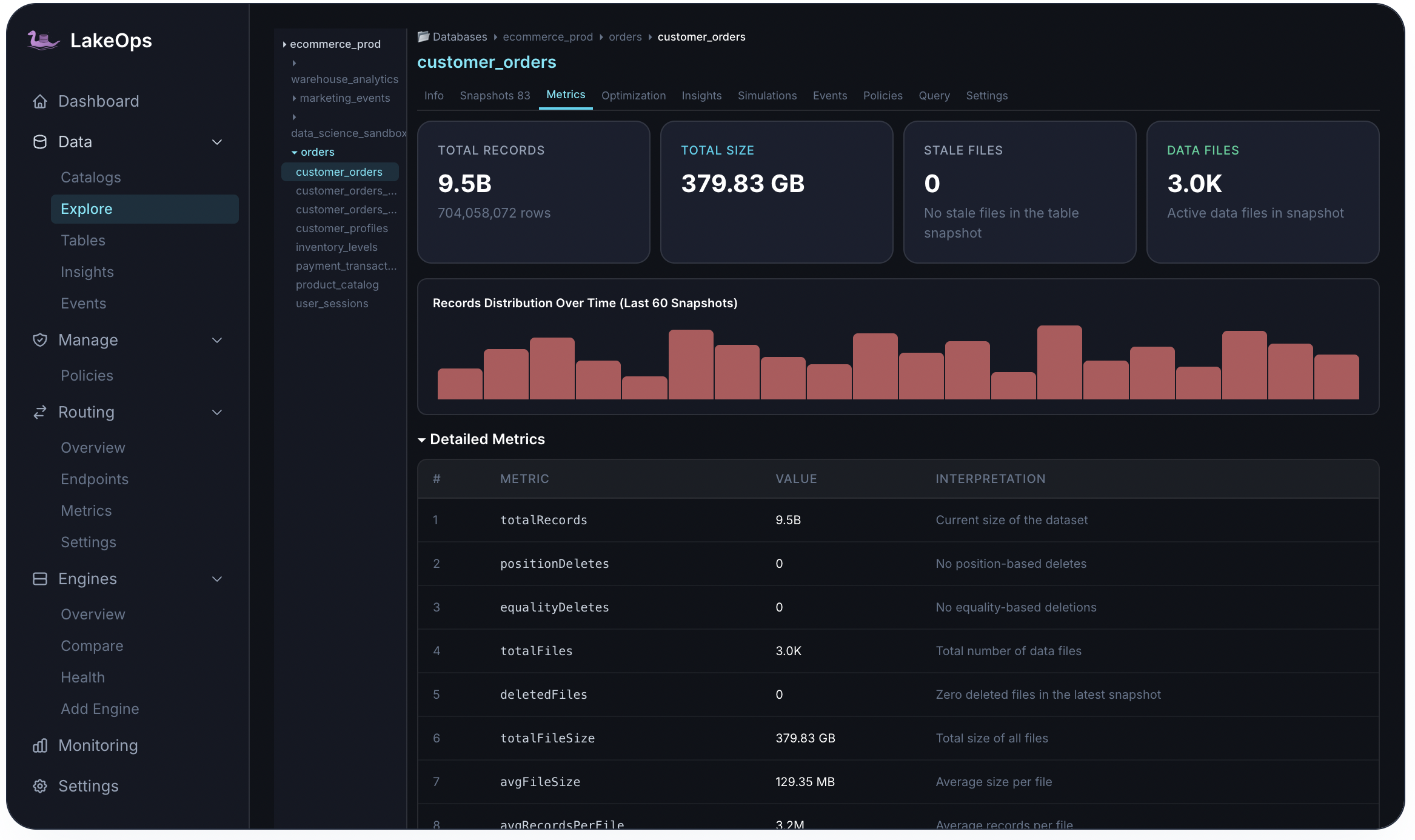
Per-table investigation without leaving the control plane
The Explore view and Metrics tab expose the full structural picture: records over time, active files, stale files, delete files, file-size histograms, and snapshot-level growth — the same data you would pull from Iceberg metadata tables, pre-joined and charted.
- Records distribution across recent snapshots — spot write-pattern changes
- File size histogram — % of files in optimal range vs. undersized
- Position and equality delete tracking for merge-on-read tables
Partition drill-down
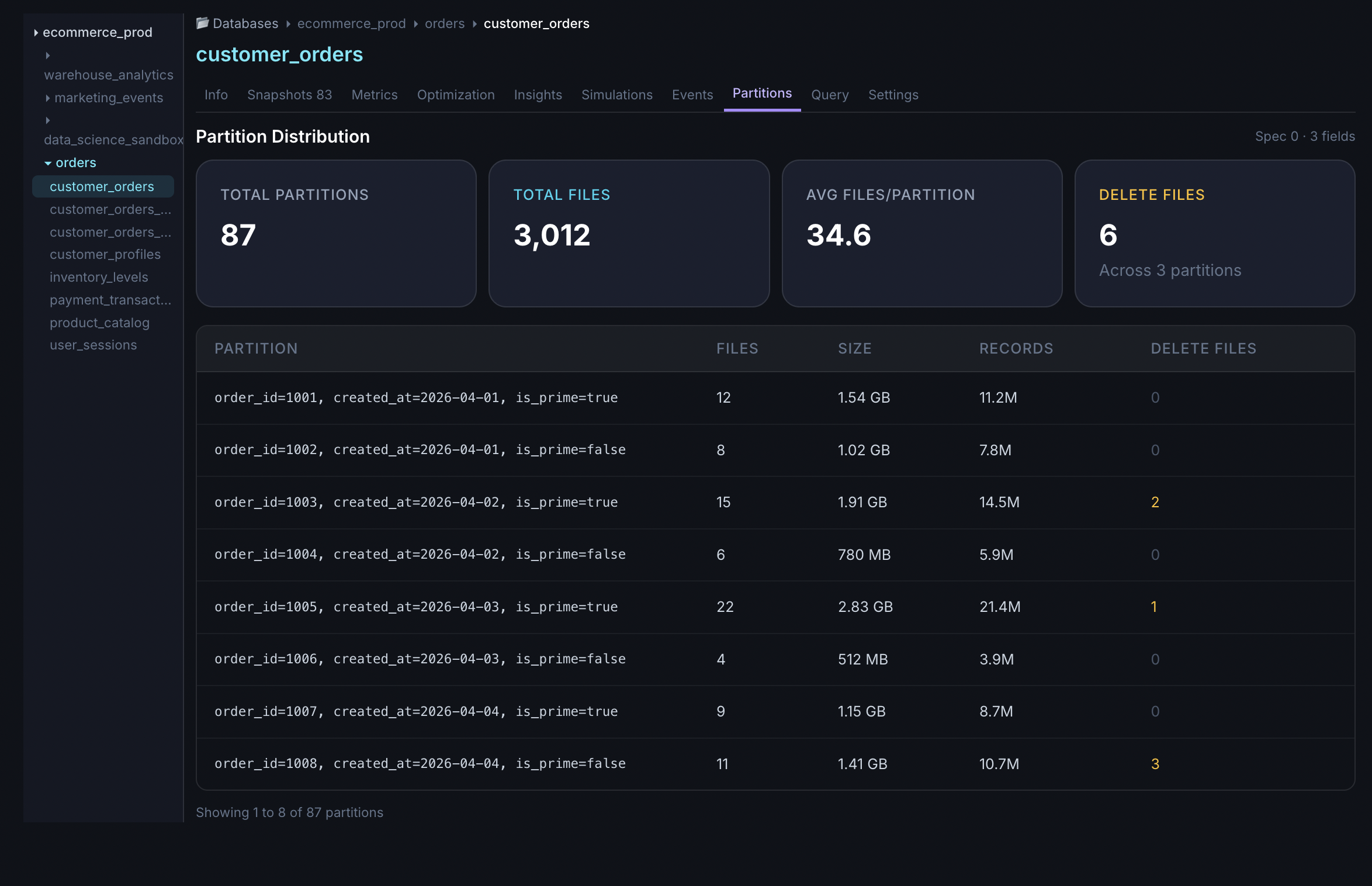
See skew and hotspots before they become outages
The Partitions view breaks down file counts, byte distribution, and delete-file concentration per partition key. Spot the partitions driving planning timeouts or runaway compaction jobs — and act before they escalate.
- Per-partition file count and byte distribution at a glance
- Delete-file hotspots highlighted across partition keys
- Identify streaming-write explosions in individual partitions
Cross-engine telemetry
See how every engine uses your tables
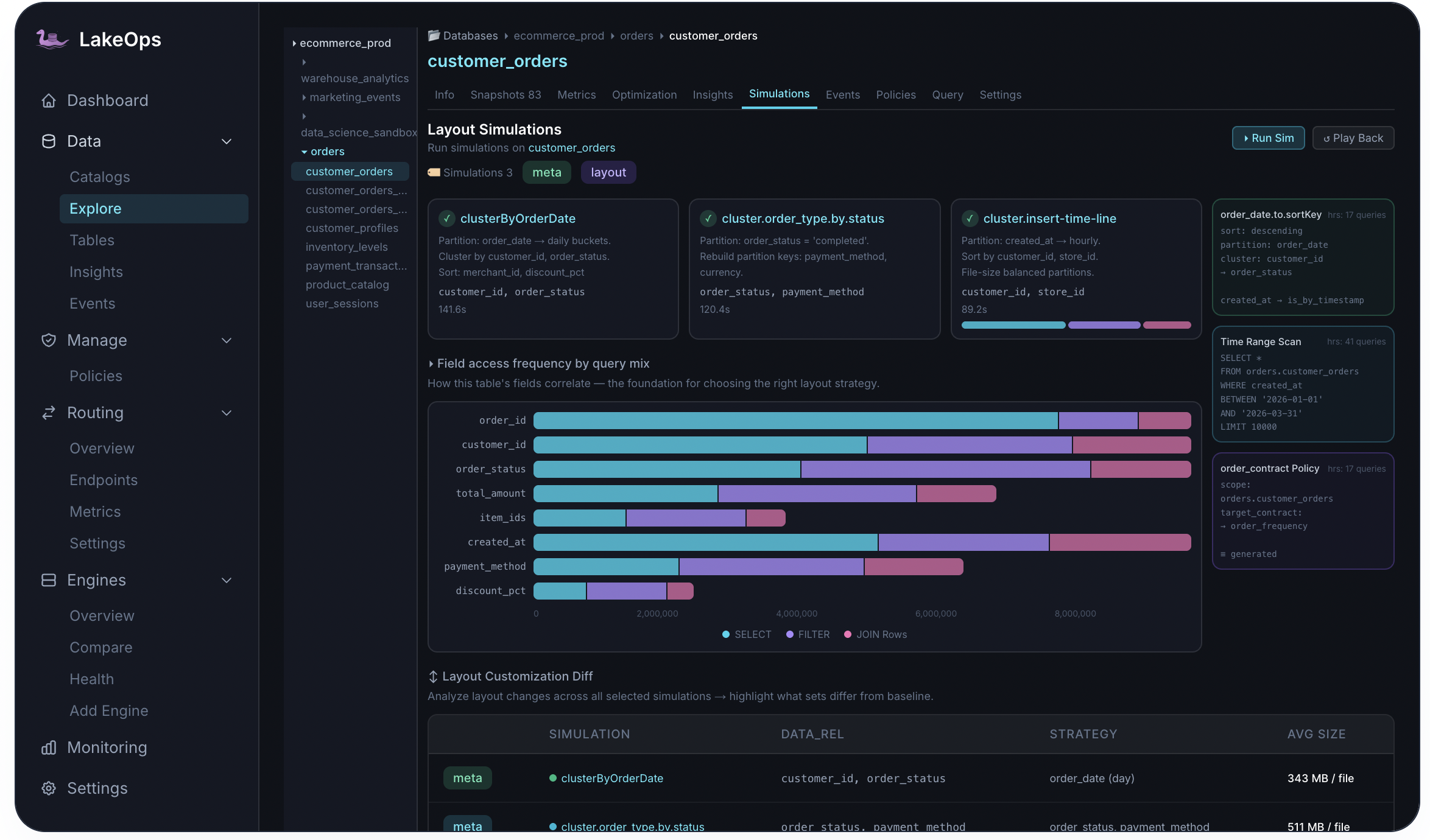
LakeOps ingests query telemetry from the engines in your stack. Field-access analysis shows which columns appear in filters and joins; engine-level views show latency and load — so observability informs both triage and downstream optimization.
- SELECT, FILTER, and JOIN frequency per column
- Per-engine query volume and latency trends
- Hot tables and cold tables — prioritize maintenance where it matters
Lakehouse Control Plane
Cost down. Performance up.
Agentic AI ready.
Observability is one layer of the control plane — explore maintenance, compaction, routing, and agentic AI alongside full lake visibility.
Intelligent Lakehouse
A unified control plane that understands your lake end-to-end — tables, engines, queries, and costs — and acts on it autonomously.
Read articleAutonomous Maintenance
Snapshot expiration, manifest rewrites, orphan cleanup, and metadata — automated, scheduled, and safe.
Explore maintenanceIntelligent Compaction
Rust-based engine that organizes data by real query patterns — every cycle cuts IO, shrinks file counts, and speeds up reads.
Explore compactionMulti-Engine Routing
Route queries across Trino, Spark, Snowflake, and more — optimized for cost, latency, or throughput per workload.
Explore routingAgentic AI Management
Agent-native MCP interface, guardrails, and a self-optimizing lake ready for AI agents, feature stores, and autonomous pipelines.
Explore AI enablementObservability & Governance
Table health, engine metrics, cross-system telemetry, and policy-driven governance from one control plane.
Explore observabilityThe gap
Iceberg gives you metadata,
not a monitoring layer
Without continuous observability, tables degrade silently. Platform teams discover manifest bloat and small-file sprawl only after query latency spikes or storage bills jump.
Iceberg has metadata, not monitoring
Metadata tables expose snapshots, files, and manifests — but no native health scores, alerting, or lake-wide dashboards. Platform teams run one-off Spark SQL until something breaks.
Visibility is split across silos
Object-storage metrics, engine query UIs, and Iceberg catalog APIs each tell part of the story. Correlating a slow dashboard with manifest bloat takes days of manual investigation.
Degradation is silent until queries hurt
Small files, manifest sprawl, and snapshot buildup compound over weeks. Planning time grows, scans widen, and nobody notices until analysts or agents report failures.
Multi-engine lakes multiply blind spots
Trino, Spark, Snowflake, Athena, DuckDB, and Flink each see the same tables differently. Without unified telemetry, you cannot tell which engine or table is actually driving cost and latency.
Connect your catalogs.
See everything in minutes.
LakeOps reads Iceberg metadata from every connected catalog, classifies table health, and surfaces insights — no agents, no pipeline changes, no manual SQL to get started.
Connect & collect telemetry

