



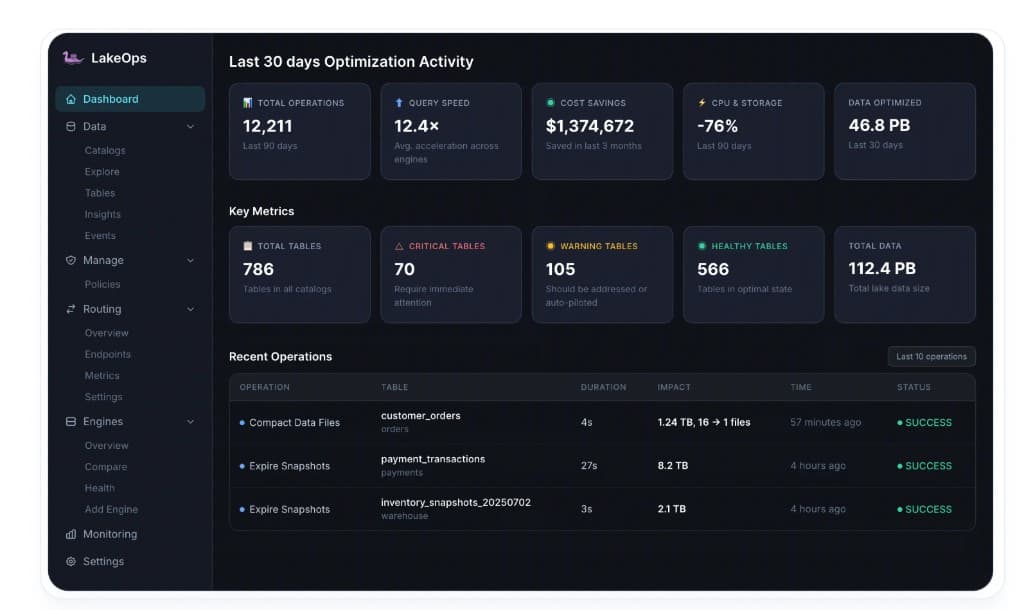
Cost Optimization
Cut Iceberg costs 80%
without changing a pipeline
Small files, snapshot bloat, orphan data, and over-provisioned compute silently inflate your cloud bill. LakeOps eliminates waste autonomously — faster queries mean less CPU per read, and that saves money on every single query your lake runs.
The core principle: Faster queries = less CPU per read = lower cost on every single query. LakeOps optimizes your data layout so engines scan less data, open fewer files, and finish faster — cutting compute spend proportionally across every engine that touches your lake.
LakeOps Results
Measured impact on
real Iceberg workloads
Benchmarks from production-grade tables across multiple engines and cloud providers.
Compaction speed
vs. Apache Spark on identical benchmark data
Query performance
After compaction + layout optimization
Cost savings
In compute & storage spend
The problem
Where Iceberg costs
silently grow
Data lakes grow by tables, not by vertical capacity. Without active maintenance, entropy compounds — files fragment, metadata bloats, and every query pays an invisible tax.
Small file explosion
Streaming, CDC, and multi-writer scenarios create thousands of tiny files. Each file open = an API call, scan overhead, and metadata cost. 47,000 files turned a 5.8s query into a 52s nightmare.
Snapshot & metadata bloat
Without expiry policies, every snapshot and its manifests remain forever. One customer had 120 TB of deletable data — $33K/yr wasted — hiding in expired snapshots alone.
Orphan files & dead data
Failed jobs, aborted transactions, stale tables from departed employees. One scan found ~200 TB of dead data (~1.8M orphan files) — $4K/month for data the tables didn't even reference.
Over-provisioned compute
Queries scan more data than needed → more CPU, more memory, more cost. Unsorted tables scan 51% more data on every query. Delete files force every read to apply filters across thousands of partitions.
How we cut costs
Smart and efficient optimizations,
autonomously managed
Not a single trick — five strategies that work together. Each one cuts waste, and together they compound to reduce total lake cost by up to 80%.
Query-aware compaction for lower compute cost
LakeOps doesn't compact on a schedule. It analyzes real query patterns, ingestion telemetry, and access heatmaps to decide what to compact, when, and how aggressively. Compaction targets the file groups that queries actually touch — so every rewrite directly translates to faster queries, lower I/O, and less CPU burn.
Examples:
- Fewer files = fewer opens = faster scan initiation. 47,000 files → 280: query dropped from 52s to 5.8s (9× faster = 9× less CPU)
- Sorted layouts enable predicate pushdown — engines skip entire file groups instead of scanning everything
- Delete files physically applied in compaction — no more runtime filter overhead on every read
- Continuously improving: same 1.2 TB table went from 22 min → 11 min across runs as the engine learned the workload
Faster queries = proportionally less CPU and compute cost per query across all engines.
Full table maintenance cuts storage and query compute
Compaction alone is not enough. LakeOps coordinates snapshot expiry, manifest rewrites, orphan cleanup, Puffin file refresh, and delete-file merges as a single automated loop. This keeps tables lean on disk and reduces the metadata and scan overhead that makes queries burn extra CPU.
Examples:
- One customer: 350 TB → 230 TB in 10 minutes (34% storage freed, $33K/yr saved instantly)
- Another: ~200 TB of dead data across 324 tables removed — $4K/month recovered
- Snapshot and manifest hygiene reduce metadata scan volume, lowering query planning CPU and query startup latency
- Delete-file cleanup and layout maintenance cut per-query I/O, so engines use less compute for the same workload
- Sorted data compresses 9% better (163 GB vs 178 GB on 1 TB Lineitem table)
- Sorted layouts cut cumulative scan size by 51% — less I/O = less CPU across all queries
120 TB freed in 10 minutes from one customer's lake. Just from expired snapshots and stale tables.
Rust compaction engine — 86% faster and lower-cost
Built in Rust with Apache DataFusion. Zero GC pauses, vectorized Arrow execution, lock-free parallelism, bounded memory per worker regardless of table size. Where Spark OOMs on a 1.2 TB table, LakeOps finishes in 11 minutes. Compaction cost per TB drops from ~$50 to ~$5.
Examples:
- 5.5 TB compacted across 10 production tables: 101,223 → 19,170 files (81.1% reduction)
- Peak throughput: 2,522 MB/s (322 GB in 2 minutes)
- 99.8% file reduction on streaming tables (42,633 → 69 files)
- Spark OOM'd on 1.2 TB. LakeOps: 11 minutes. Same hardware.
- Compaction cost: $0.21 per 200 GB (binpack) vs Spark $1.54 — 86% cheaper
~$5/TB (LakeOps) vs ~$50/TB (Spark, S3 Tables, Databricks). Same output quality.
Intelligent workload routing across engines
Not every query needs the same engine. LakeOps profiles access patterns, partition heatmaps, and engine cost profiles to route each workload to the cheapest compute path that meets its latency target. Works across Snowflake, Databricks, Trino, StarRocks, Athena, DuckDB — without code changes.
Examples:
- Route analytics to cold-tier engines, interactive queries to hot-tier — automatically
- Engine-level spend visibility per table, per user, per pipeline
- Predictive routing based on cost, latency, and data locality
- Burst workloads across available engines during peak hours
Production customer: storage reduced 47%, compute reduced 65% across 100 tables.
Simulate before applying — guaranteed safe savings
LakeOps doesn't blindly rewrite data. It runs offline simulations on representative data slices, estimates the impact on cost, latency, and scan efficiency, and only promotes changes that demonstrably improve outcomes. Manual review mode or fully autonomous autopilot — you choose.
Examples:
- Simulations run on branches — zero impact to production until promoted
- Predicted vs observed impact tracking on every optimization
- AI decides what to run, when, how, and on which engine — or you approve each step
- Every action logged, explainable, and reversible. Full audit trail.
Nothing touches production until simulation confirms the win. Rollback at any point.
Runs on your stack
Production benchmarks
5.5 TB across 10 production tables
Real workloads. Real data. Batch, streaming, delete-heavy, multi-writer, and terabyte-scale tables — all on the same engine, same hardware.
| Table | Size | Workload | Files (B → A) | Throughput | Time | Notes |
|---|---|---|---|---|---|---|
| balance_snapshots | 1,192 GB | TB-Scale batch | 11,957 → 3,270 | 1,572 MB/s | 11 min | Spark OOM on same hardware |
| user_accounts | 174 GB | Batch | 878 → 400 | 2,269 MB/s | 74s | Single Node |
| events_analytics | 484 GB | Delete-Heavy | 16,128 → 7,198 | 729 MB/s | 11m 21s | 23,433 delete files; 551M rows removed |
| raw_sdk_events | 8 GB | Streaming | 42,633 → 69 | 167 MB/s | 138s | 99.8% file reduction |
| site_traffic | 292 GB | Multi-Writer | 2,740 → 754 | 1,465 MB/s | 3m 25s | Single partition |
| cluster_registry | 322 GB | Batch | 998 → 440 | 2,522 MB/s | 2m | Peak throughput |
Compaction cost per TB
Normalized to Spark = 100%
Source: 200 GB (~1 TB uncompressed) benchmark. Spark cost index 100 vs LakeOps 10.
Self-improving: same table, zero config changes
balance_snapshots — 1.192 TB across consecutive runs
Same data and hardware; planner learns workload telemetry and improves runtime from 22 to 11 minutes.
Agentic AI readiness
Ready for agentic AI,
built for cost-efficient scale
This page is about cutting cost, and this is where it compounds: optimized Iceberg tables let agents run more tasks with less query compute and more predictable spend.
Lower token-to-query cost
Faster, cleaner tables mean agents execute fewer expensive retries and complete tasks with less compute.
Agent-safe optimization loop
LakeOps simulates and validates changes before promotion, so autonomous workflows can scale without surprise regressions.
Scale AI workloads confidently
As agent query volume grows, adaptive compaction and routing keep query latency and infrastructure spend predictable.
Super high ROI
LakeOps pays for itself.
No credits, no surprises.
LakeOps continuously trims storage and compute waste so savings keep pace with and typically exceed what you pay for the platform. Pricing stays straightforward: a management fee plus per-TB usage, with no credit bundles, guesswork, or surprise overages.
Super-high ROI from day 1
Avg. 60–80% costs saved
If you pay, you save more
Flat TB-based pricing
No credits complexity
Full visibility and control
Minutes to value with zero risk
No agents. No data movement. No pipeline changes. Connect your catalog, get a full cost analysis, and start optimizing.
Connect your catalog
Point LakeOps at Glue, Polaris, Unity, or Lakekeeper — 10 minutes, zero data movement.
Instant health scan
Full lake analysis: small-file hotspots, stale snapshots, orphan files, manifest issues, query-pattern mismatches, and table priority scoring.
Simulate & preview savings
See projected cost and performance impact before anything runs. Approve per-table or enable autopilot with guardrails.
Continuous autonomous optimization
Compaction, cleanup, layout optimization, and routing run on autopilot. The engine learns and improves with every run — zero config changes needed.
See your projected savings
Connect your catalog and get a free cost analysis in 10 minutes — see exactly where your Iceberg lake is overspending and how much LakeOps can save. If the control plane costs more than it saves, something is very wrong.