




Data Lake for Agentic AI

Beta

Your data lake,
ready for AI agents

AI agents are becoming primary consumers of SQL infrastructure. LakeOps is the control plane that makes your lake intelligent — agent-native interface, built-in guardrails, self-optimizing storage, and a closed-loop feedback system that learns from every query.

0ms
cached routing decisions
65%
lower query compute cost
100%
agent query auditability

The challenge

AI agents deserve a data lake built for them

Agents hit slow, stale tables

AI agents issue SQL expecting sub-second latency. Uncompacted tables with small files and bloated manifests force full scans, turning a simple lookup into a 10× slower query.

No guardrails for autonomous SQL

Agents running unsupervised can issue DDL, scan petabytes, or expose PII. Without layered safety policies, every agent query is a compliance and cost risk.

Wrong engine, wrong cost

An interactive agent query landing on a batch engine wastes minutes and compute. Without workload-aware routing, agents can't pick the fastest or cheapest path.

No feedback loop

Agent workloads change constantly, but tables stay static. Without a closed-loop system that feeds query signals back to the optimizer, the lake never adapts to how agents actually use it.

Capabilities

Everything agents need from your lake

A unified control plane purpose-built for agentic workloads — connection, safety, routing, optimization, and observability.

Agent-native MCP interface

Native MCP server connects any compatible agent — Claude, LangChain, or custom — with zero integration code. Schema-aware tools, async queries with SSE streaming, and Postgres/MySQL/Arrow Flight wire compatibility.

Layered safety guardrails

ReadOnlyGuard blocks DDL, CostEstimateGuard rejects expensive scans, PIIMaskGuard scrubs sensitive columns, HumanApprovalGuard pauses high-stakes queries. Stack them per agent, per team, or globally.

Intelligent multi-engine routing

Three-router stack — Adaptive routes on history, LLM reasons over new templates with live table stats, Semantic matches intent. 0ms cached decisions, data-quality-aware routing enriched by table health.

Self-optimizing storage

Agents querying uncompacted tables pay 5–10× latency penalty. The workload analyst feeds agent query signals to the Rust compaction engine, and the feedback loop auto-updates routing as tables improve.

Query observability & audit

Every agent query is logged, attributed, and explainable. See which agents query which tables, what guardrails fired, which engine was chosen, and why — with full cost and latency attribution.

Closed-loop feedback

Agent workload patterns flow back to the optimizer: hot tables get compacted first, partitions evolve to match access patterns, and routing weights adjust automatically as data quality improves.

Agentic AI enablement

Live routing control
for autonomous workloads

Bring the platform-grade endpoint routing experience directly into your data-lake workflow: isolate workloads, enforce policy, and continuously tune where agent queries run.

Routing Endpoints

Groups

4

Configured endpoints

Active

3

Passing traffic

Inactive

1

Paused groups

Endpoints

8

Publicly available

All routing groups

Storefront Analyticsactive

Interactive customer behavior and funnel exploration workloads.

storefront-analytics.lakeops.dev
Engines: TrinoDuckDB
Query types: SELECTAGGREGATE
Updated Mar 16, 2026 03:20 PMHigh
Checkout Transactionsactive

Operational writes and near-real-time checkout event ingestion.

checkout-transactions.lakeops.dev
Engines: SnowflakeStarRocks
Query types: INSERTUPDATEMERGE
Updated Mar 16, 2026 02:10 PMMedium
Catalog ETLinactive

Nightly catalog transformations and product availability sync jobs.

catalog-etl.lakeops.dev
Engines: AWS AthenaSpark
Query types: INSERTDELETE
Updated Mar 15, 2026 11:42 PMLow
Executive Reportingactive

Scheduled BI reports and financial dashboard refresh workloads.

executive-reporting.lakeops.dev
Engines: SnowflakeTrino
Query types: SELECTJOIN
Updated Mar 16, 2026 01:07 PMMedium

Cost-effective scale

Lower cost per agent query,
built for efficient scale

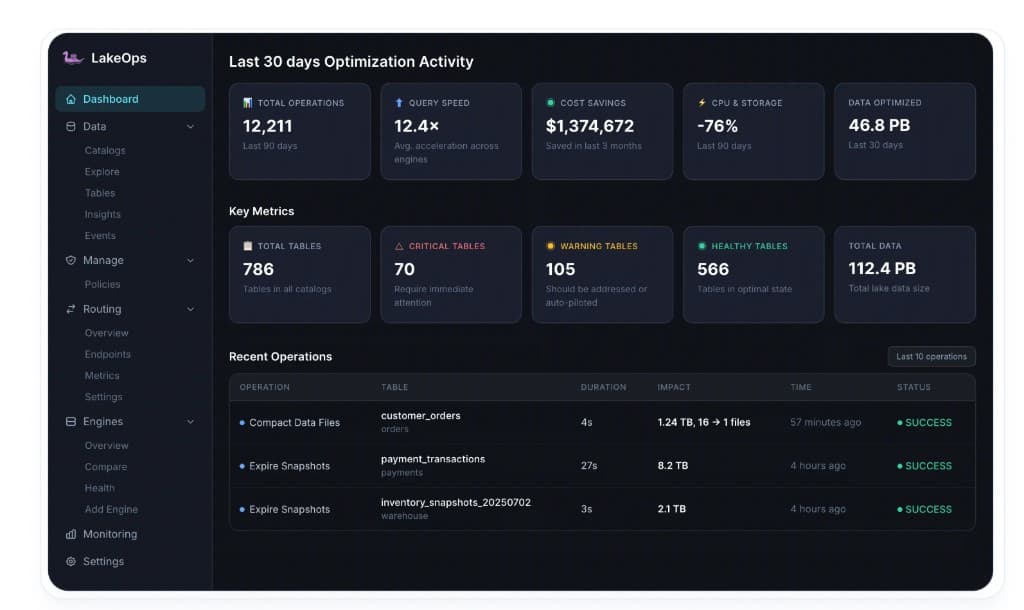
This page is about cutting cost, and this is where it compounds: optimized Iceberg tables let agents run more tasks with less query compute and more predictable spend.

Lower token-to-query cost

Faster, cleaner tables let agents finish tasks with fewer retries and lower compute per query.

Agent-safe optimization loop

Every optimization is simulated and validated before promotion, so autonomous workloads scale without cost spikes.

Cost-effective AI scale

As agent traffic grows, adaptive compaction and routing keep latency stable and infrastructure spend predictable.

How it works

From agent query to optimized result

A closed loop: agents connect, policies enforce, routers decide, and the lake self-optimizes — continuously.

1

Agents connect via MCP

Any MCP-compatible agent — Claude, LangChain, custom builds — connects to LakeOps with zero integration code. Schema-aware tools are auto-discovered.

2

Guardrails enforce policy

Every query passes through stackable guards — read-only, cost ceiling, PII masking, human approval — before it reaches an engine.

3

Router picks the engine

Adaptive, LLM, and semantic routers choose the fastest and cheapest engine based on query shape, table health, and history. Cached decisions take 0ms.

4

Lake self-optimizes

Agent query signals feed back to the Rust compaction engine. Hot tables compact first, partitions evolve, and routing weights update as data quality improves.

Make your lake agent-ready today

See how LakeOps connects AI agents to your Iceberg tables — safely, fast, and autonomously.

MCP nativeLayered guardrailsMulti-engine routingSelf-optimizing